George Orwell: Treacle Tart

George Orwell - Treacle Tart

Imagine this: It’s a Sunday night, the end of a long weekend full of gift shopping, cookie baking, and fun-but-exhausting holiday merrymaking. You can’t possibly cook now, you decide, and turn to your trusty takeout-menu drawer. What are you in the mood for, though? Thai? Italian? Indian? Ethiopian?

If there’s one thing I bet you didn’t say, it’s “British.” Despite the U.K.’s recent restaurant renaissance, its meals have been a culinary punchline for nearly a century, ever since World War I hobbled the country’s food culture. George Orwell summed up its characteristics rather bluntly: “simple, rather heavy, perhaps slightly barbarous.”

Orwell was obviously never one to hide his feelings about food; his travel writings slam chefs everywhere from France to Burma. You’d think he’d be a little kinder to his home cuisine, but he savages everything from fish and chips (“definitely nasty, and has been an enemy of home cookery”) to rice puddings (“the kind of thing that one would prefer to pass over in silence”) to pretty much any kind of vegetable (“usually smothered in a tasteless white sauce”).

But Orwell did reserve some praise for what was, in his mind, Britain’s crowning culinary glory: “sweet dishes and confectionery—cakes, puddings, jams, biscuits.” Best of all were the Christmas treats: plum pudding, and treacle tart, “a delicious dish … hardly to be found in other countries.”

So how could a food lover like Orwell explain the U.K.’s mediocre showing in the kitchen? As he tells it, it’s because the best English cooking isn’t at a charming bistro or fancy restaurant, but is made at home, where foreigners don’t have access. That may be bad news for tourists—but it’s a moment for home cooks to shine. When we’re baking scones or Yorkshire puddings, Orwell says, we can be chefs of our own making.

* * *

orwell images

Continue reading “George Orwell: Treacle Tart”

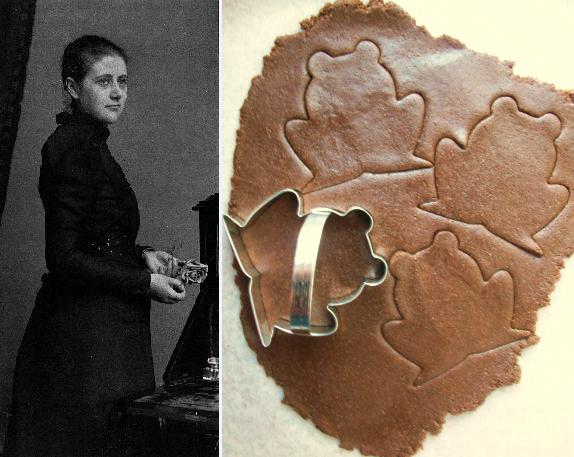
Beatrix Potter: Gingerbread Cookies

Among all children’s authors I loved growing up, Beatrix Potter always seemed the most wholesome by far. My favorite books were the eyebrow raisers: the delicious nastiness of Roald Dahl, the nightmarish worlds of Maurice Sendak. Even The Velveteen Rabbit gets borderline traumatizing. When the only person you truly love gets scarlet fever, and all your friends are burned, you can finally become “real” if you cry? That’s more drama than a episode of Dawson’s Creek.

I remembered Peter Rabbit and Jeremy Fisher as cuddly and innocent in comparison, but on a recent visit to the Morgan Library, I realized I had it all wrong: Potter had a not-so-secret dark side. Not a book goes by without some cute animal about to be skinned, drowned in a sack, or baked in a pie. Potter began her original draft of The Tale of Mr. Tod, “I am quite tired of making goody goody books about nice people.” Her editor nixed it; turns out, readers wanted those goody goody books.

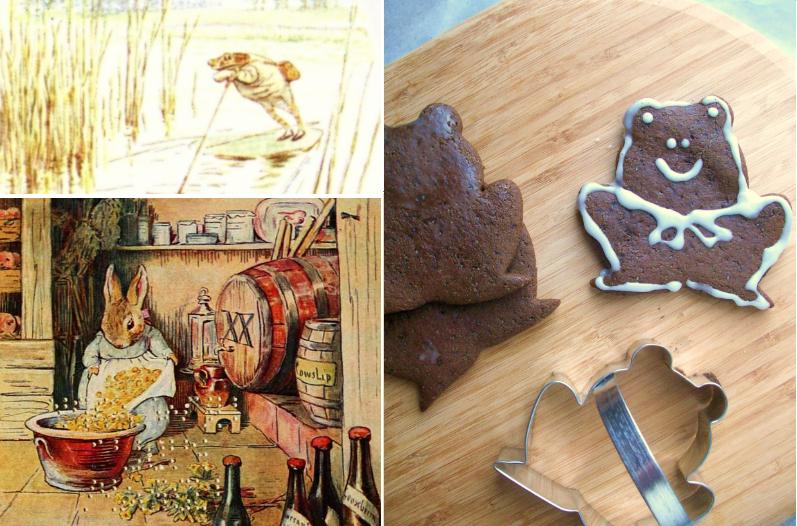
Still, a few less-than-goody bits made it into print. One of my favorite Potter characters is Cecily Parsley, an adorable rabbit who moonlights as a beer brewer. Potter’s illustrations show Cecily soaking some barley in front of comically large barrels marked “XX.” It’s impossible to imagine other favorite children’s characters doing the same: Anne of Green Gables opening up a distillery, or the Goodnight Moon mouse tippling on some homemade hooch.

Did Potter take a cue from Cecily and start her own homebrews? Probably not. She did cook; at her beloved Hill Top Farm, in England’s Lakes District, she planted an herb and vegetable garden that Peter Rabbit would have loved to pillage. Much of her produce came from those gardens, but not all her recipes were virtuous. When Potter’s family recipe book went up for auction this fall, hiding in her gingerbread was a good dose of ale—a little bit of naughty in the midst of all that sugar, spice, and everything nice.

* * *

Continue reading “Beatrix Potter: Gingerbread Cookies”

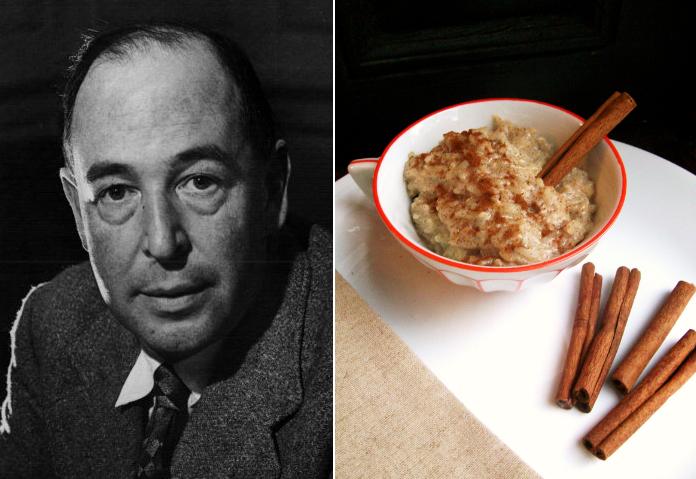
C.S. Lewis: Cinnamon Bourbon Rice Pudding

With Sartre and his halva addiction, Agatha Christie and her devotion to cream, and Wallace Stevens’ cookie obsession, writers seem to thrive on a sugar high. Halloween must be a very productive time of year, creatively speaking: too gloomy to go outdoors, and lots of candy at hand to fuel the creative spark. It makes you wonder how many Great American Novels could only have been written with a steady supply of cake, cookies, and caffeine.

But just as I was beginning to think that sweets were the secret to success, C.S. Lewis broke the mold. He is not only ambivalent toward candy – he actually refuses to eat it. To someone whose favorite part of Halloween is stocking up on half-price Reese’s the morning after (don’t judge), this is the most harrowing discovery of the season.

Lewis comes up with various excuses for avoiding sugary treats: “I’m getting terribly fat and have had to diet” or “I can’t afford to buy a new wardrobe every few months!” He once wrote to a friend, who apologized for sending him stationery rather than sweets, “I must confess that I eat notepaper and envelopes, so your very kind gift may be described as being that of the edible variety.” Which is all to say what Lewis would ultimately admit: “I have not a sweet tooth.”

But his distaste for the insubstantial went further than food. Lewis also disdained literature that went down a little too easily. He cautioned a friend against detective novels, saying, “A little sense of labour is necessary to all perfect pleasures I think: just as (to my palate at least) there is no really delicious taste without a touch of astringency … The apple must not be too sweet.” Who would have thought the immortal creator of Narnia could wind up being the trick-or-treater your mother would love: He’ll leave the M&Ms, and ask for a Granny Smith instead.

* * *

Continue reading “C.S. Lewis: Cinnamon Bourbon Rice Pudding”

Henry James: Vanilla Ice Cream with Brandied Peaches

vanilla ice cream brandied peaches recipe

Around the middle of August, when vacations are past and sunset creeps up noticeably earlier every evening, end-of-summer anxiety sets in. How could I have let this happen? I didn’t have nearly enough picnics! Or take enough strolls through the park! Or eat all the corn, cherries, and peaches that summer demands! Suddenly, every weekend is wasted unless it includes at least one rooftop meal and one — okay, two — stone-fruit desserts.

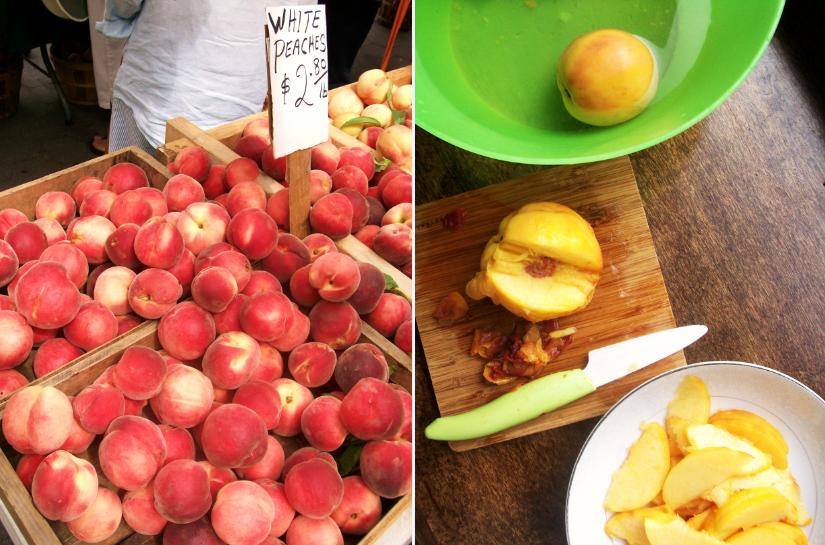
If that seems overly dramatic, you should hear Henry James tell it. Born and raised in Manhattan, he would run errands with his mother to Washington Market, where farmers unloaded their produce onto the Hudson piers. He was struck by the bounty of summer there, “bushels of peaches in particular, peaches big and peaches small, peaches white and peaches yellow,” he wrote in A Small Boy and Others. “Heaps of them, the high-piled receptacles at every turn, touched the street as with a sort of southern plenty.”

When James wrote about losing the fruit of summer, though, he wasn’t just bummed there’d be no more pie for a while. In typical Jamesian fashion, the end of the market was a reminder of the passing of youth and (if we want to get really profound) of a bygone era. “What did the stacked boxes and baskets of our youth represent but the boundless fruitage of that more bucolic age of the American world …? Where is that fruitage now? Where are the peaches d’antan?”

Elegies like that make me feel like I should get to pondering Questions of Significance, not of granita recipes. But then I remember that James’ love of summer produce wasn’t entirely symbolic. In 1874, preparing to return home from a trip to Germany, he implored his mother, “Be sure about Sept. 4 to have on hand a goodly store of tomatoes, ice-cream, corn, melons, cranberries and other indigenous victuals.” Whenever I visit my family in California, I make practically the same request. And every Sunday, my mother and I make a run to the farmers’ market. There, even in winter, when my New York market stalls are all brown root vegetables, the stands still overflow with the colors of an everlasting summer.

* * *

peaches farmer's market

Continue reading “Henry James: Vanilla Ice Cream with Brandied Peaches”

Nora Ephron: Frozen Key Lime Pie

My first Nora Ephron experience was watching When Harry Met Sally backwards. It was the week between Christmas and New Year’s Day, that week when cable channels run marathons of the film, back to back, all day long. On holiday from school, with nothing better to do, I randomly flipped on the TV to the last scene, when Billy Crystal and Meg Ryan finally end up together and everyone sings “Auld Lang Syne.” I stumbled upon another scene later that day, on a different showing: the epic fight over the wagon wheel coffee table. Finally, I caught it at the beginning and watched the whole thing. Seeing it that way was pleasingly disorienting — Nora Ephron meets Harold Pinter.

Ephron might not fit the mold of other writers on this blog—Crazy Salad doesn’t occupy the same place as Crime and Punishment, nor should it—but she was in a class of her own when it came to pure food joy.” I have a friend whose mantra is: You must choose,” she said. “And I believe the exact opposite: I think you should always have at least four desserts that are kind of fighting with each other.”  She wasn’t shy to share her culinary opinions, either, particularly in the Great Egg White Controversy of 2007. Her recipe for egg salad began: “Boil 18 eggs, peel them, send six of the egg whites to friends in California who persist in thinking that egg whites matter in any way.”

It’s no surprise, then, that food made its presence felt in Ephron’s fiction writing too. Her 1983 novel Heartburn is maybe the best example, seamlessly integrating recipes into the plot. Now the novel/memoir-with-recipes genre seems ubiquitous—everyone from Kim Severson to Ruth Reichl has one—but Ephron did it first, and best. She knew that cooking and storytelling share a common thread: The words draw people in, and the food draws people together. Some books are best enjoyed in solitude, but not Nora’s. They beg to be shared, the best passages read aloud to anyone around to hear them.

I got the news that Ephron had died right before boarding a plane for California, where I grew up. Back in my family’s kitchen, I started squeezing the juice for her Frozen Key Lime Pie. Although I had read many of her recipes over the years, this is the first one I was attempting. Finally, I thought, I’d have what she was having.

* * *

Continue reading “Nora Ephron: Frozen Key Lime Pie”

Wallace Stevens: Coconut Caramel Graham Cookies

If cookies were a literary genre, I suspect they’d be the romance novel. Neither one gets much respect in highbrow circles, but both have a dedicated, verging-on-rabid following. They’re the perfect accompaniment to a rainy Sunday afternoon – and it’s dangerously easy to consume several in one sitting.

But unlike romances, with their embossed and be-Fabio’ed covers, cookies aren’t winning any beauty contests. They’re usually not much to look at, which is one reason why they’re more often found in our home kitchens than on restaurant menus. They’re homely in every sense.

If you had met him on the street, you might have thought Wallace Stevens was similarly unremarkable. Every day for over 40 years, he got up, got dressed, and commuted to his achingly normal day job at a Connecticut insurance agency (Kafka also worked in insurance, which makes you wonder just what goes on over there). His humdrum evening routine consisted of eating a cookie while reading the paper. He didn’t publish his first poem until he was 35, and even after he won the Pulitzer, he still went to the office every day, and ate a cookie every night.

No other writer talks about cookies as much as Stevens does. Elsie, his wife, always seemed to have a batch baking; “I can almost smell them,” Stevens wrote in his letters. He brought them on picnics, and gave boxes of them away as Christmas gifts. Even Stevens’ daughter associated  with cookies; when he was away on business, she would put a cookie by his place at the table, waiting for him to come home.

Stories like that remind me why cookies, despite their homely status, are so beloved: They tie in to our most cherished memories, and remind us of those little moments that make life worth living. Stevens knew that power well. In 1948, after returning from a trip to New York with Elsie, he wrote, “We went into the kitchen, sat there drinking milk and eating cookies. … This is not much. Yet it is a little in spite of everything.”

* * *

Continue reading “Wallace Stevens: Coconut Caramel Graham Cookies”

Truman Capote: Italian Summer Pudding

How long can you last before thinking about what to cook for dinner? It’s a rare occasion when I make it past lunch. Usually by my morning commute, I’m already gone – dreaming up recipes as I walk to the subway, devising shopping lists at lunch, dropping by the farmers’ market on the way home. So I know how Truman Capote felt when he wrote: “Food. I seldom think of anything else.” That kind of sums it all up, doesn’t it?

I’ve always loved eating food, but it wasn’t until I moved to New York—and had a kitchen to myself—that I began to love cooking it. If an aspiring writer needs a room of her own, a budding chef needs a kitchen: a private laboratory where she can experiment to her heart’s (and stomach’s) content. Capote’s chance came in 1950, when he settled down in Sicily with his partner Jack Dunphy. Capote always had a personal cook, but in Sicily he began to explore the kitchen himself – “an unmanly activity, I suppose, but very relaxing and the reward is delicious,” he wrote after a day making fruit preserves. Plus, he noted, storing jam was great way to “do something with these old gin and wine bottles,” a tip destined for the Pinterest boards of boozehounds everywhere.

What began as a way to pass the time became a food obsession, with a particular focus on sweets. After graduating from humble Toll House cookies to fancy chocolate confections, Capote ultimately took on the amateur cook’s triathlon: For Christmas in 1951, he presented Dunphy with a turkey, chestnut stuffing, and a multilayer orange almond cake.

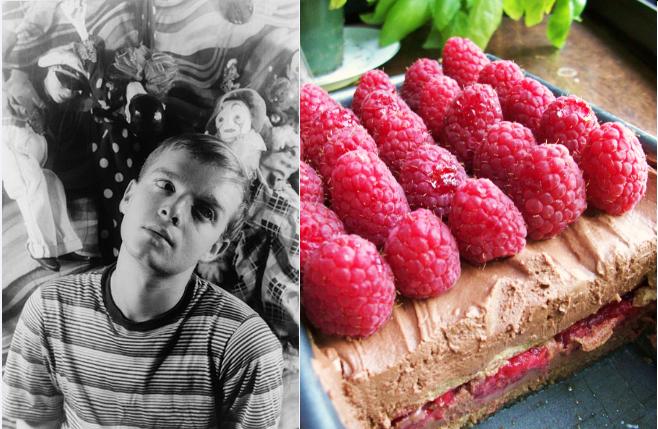
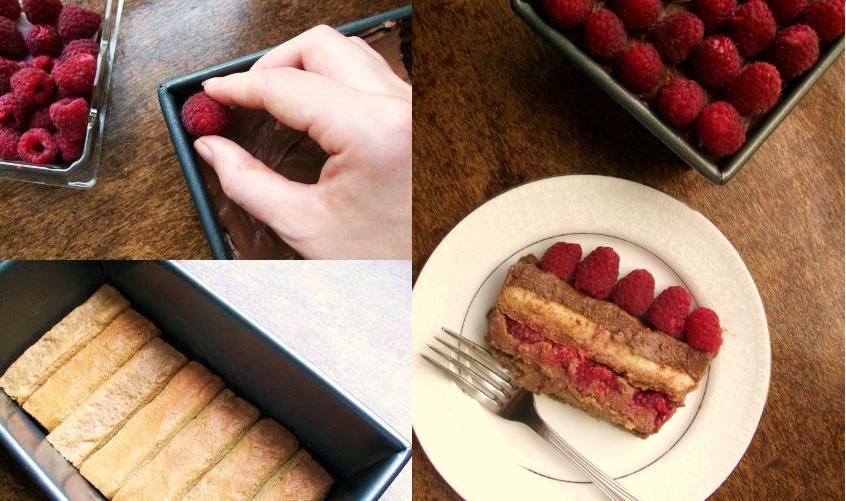
Despite his new culinary chops, though, Capote’s favorite treat was something he didn’t make. In 1962, on a trip to England, he and his friend Cecil Beaton lunched with the Queen Mother. But the royal company didn’t impress Capote – the dessert did. It was “the best cake I’ve ever tasted – a sort of chocolate cream stuffed with fresh raspberries,” he wrote. He wasn’t shy about expressing his enthusiasm, either; years later, Beaton remembered his friend cheering with joy when it was served. Because when a good dessert is involved, who can be bothered with a stiff upper lip?

* * *

Continue reading “Truman Capote: Italian Summer Pudding”

Sylvia Plath: Lemon Pudding Cakes

Is it taboo to write about baking and Sylvia Plath? When I told a friend what I was cooking this week, his face froze in a half-smile. “Oh, um, ha! But really, what are you making?” Another awkward reaction: “Well … be careful?”

I still feel like I’m tiptoeing around the elephant in the room every time I mention an oven. But, as for many a 1950s-era wife and mother, cooking and baking were large parts of Plath’s daily life, and not unwelcome ones. “How I love to cook!” she wrote in her journals – and apparently she was no slouch either. Ted Hughes praised his wife’s cooking in his letters: “Sylvia by the way is becoming the most superlative cook I’ve encountered.” To him, she was “a princess of cooks.”

We tend to think of cooking, and particularly baking, as a soothing, cathartic experience. But, as anyone who has put together a dinner party (much less run an actual bakery) can attest, it can lead to some very un-soothing thoughts. Did I beat the eggs enough? Shouldn’t it be rising more? What if I didn’t grease the ramekins enough and half of the cake sticks and then it breaks in half and the whole thing is ruined and then what will I do? THEN WHAT?

Plath seemed to have a similar dual reaction to her time in the kitchen; it was both a blessed release and a warning sign, a suffocating dead end. In 1957, after a day spent baking a pie, Plath worriedly wrote in her journal, “You will escape into domesticity & stifle yourself by falling headfirst into a bowl of cookie batter.” It’s an uncomfortable moment, a hint of things to come.

* * *

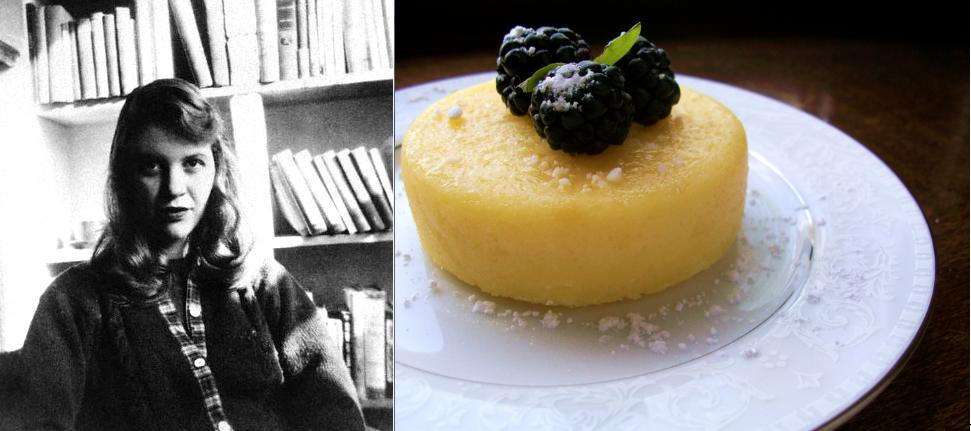
Sylvia Plath Lemon Pudding Cake

Continue reading “Sylvia Plath: Lemon Pudding Cakes”

Charles Dickens: Apples à la Princesse

Thinking of Dickensian food conjures up two extremes – the stuffed goose and figgy pudding feast of A Christmas Carol and the sad gruel rations of Oliver Twist. During Dickens’ 200th birthday celebrations this month, there was a lot of talk of the former. Nobody seemed as excited about the gruel, but there are plenty of resources to help you make an authentic Victorian version that actually sounds kind of great (Favorite BBC quote: “We were hoping he’d make it far more disgusting.”)

Given the fame that Dickens achieved in his lifetime, he didn’t have to beg for second helpings. But one of his favorite dishes, baked apples, was quite simple, not to mention practical: He swore by their ability to prevent seasickness.

Dickens became a baked apple convert while sailing to Boston in 1867. They were served at every meal during the Atlantic crossing, and he always helped himself. “I am confident that they did wonders, not only at the time, but in stopping the imaginary pitching and rolling after the voyage is over,” he wrote to his sister-in-law, Georgina Hogarth.

The magical apple diet clearly made an impression, and in 1881 Charles Dickens Jr. dedicated an entire cookery column to them in Household Words, a revived version of his father’s weekly magazine. Apples were getting cheaper and were beginning to be imported from abroad, so baked apples could be made by anyone, anytime. Perhaps thinking of his father, Dickens Jr. stressed the health benefits of the fruit. “It is unnecessary to say how valuable apples are as an article of diet.” Turns out, Dickens had been on the edge of a trend: The earliest version of our famous “An apple a day” saying was first published in Wales in 1866, just a year before his trip to the States.

* * *

Continue reading “Charles Dickens: Apples à la Princesse”

Elizabeth Bishop: The Brownie Recipe

Baking, especially baking bread, is one of those activities that is perennially nerdy-cool, like knitting or discussing artisan teas. If you’ve ever talked with rhapsodic satisfaction about your sourdough starter, you’re a part of it. But you’re not the first.

Elizabeth Bishop was one of the earliest to recognize the proto-hipster qualities of baking from scratch, after the 1920s inventions of Betty Crocker mixes and Wonder Bread made it unnecessary. “My part-time work at present seems to be baking bread,” she wrote to Robert Lowell in 1960, adding presciently, “it sounds food-faddish I’m afraid.”

Although she was always an occasional baker, making treats for cake sales and birthdays, it wasn’t until landing in Brazil in 1951 that Bishop made it a habit. Her trip, which began as a travel fellowship, turned into a 15-year stay, and she soon became a very popular neighbor thanks to one of her signature recipes: brownies.

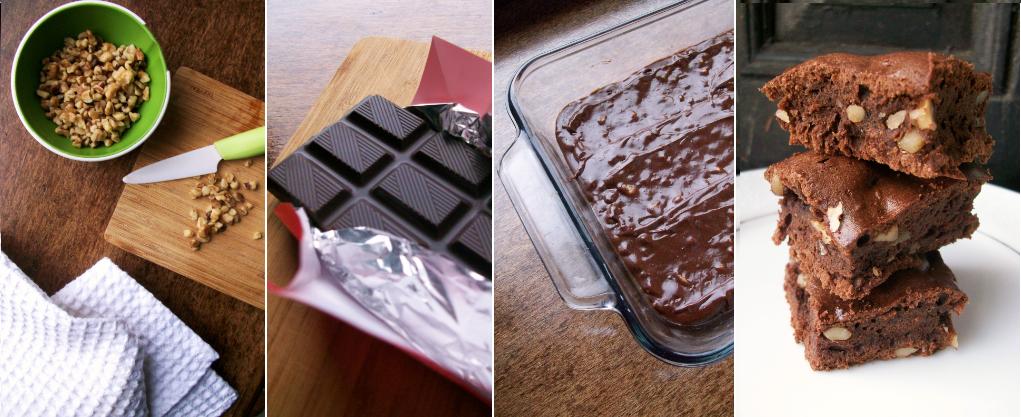
The earliest published recipes for brownies appeared in Chicago and New England the early 1900s, but according to Bishop they hadn’t made it to South America by the 1950s. Her version was an instant hit. “Since Brazilians are mad about anything chocolate … I have been requested to bring along 4 dozen brownies (something I’ve introduced to Brazil) and a large chocolate cake,” she writes to Lowell in the fall of 1957. “You see how innocent our lives are here—just making money and eating sweets.”

There’s an intimacy about baking, which might be why I always like to celebrate Valentine’s Day with homemade desserts. But reading from the correspondence between Bishop and Lowell is just as romantic to me – no bodice-ripping, but plenty of wit, flirtation, and the kind of tenderness that bespeaks a very deep love.

* * *

Continue reading “Elizabeth Bishop: The Brownie Recipe”