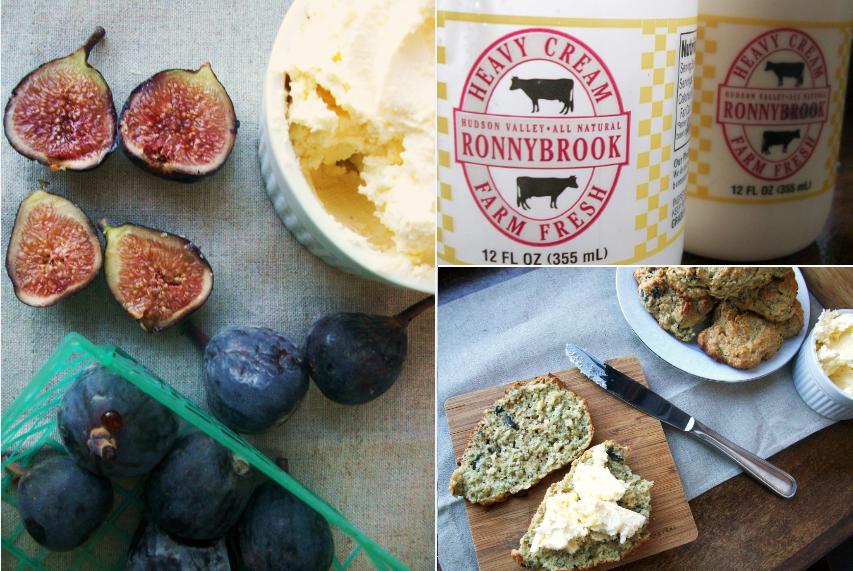
Agatha Christie: Fig and Orange Scones with Devonshire Cream

Certain foods defy any attempt at portion control. Think chocolate chips, or those disturbingly addictive pretzel pieces that must be flavored with some kind of stimulant in addition to the honey mustard. I have such a Cheez-It obsession that, studying abroad in Paris and unable to find them in any grocery, I ordered three boxes online in a hunger-fueled panic. My host mother – who, in typical French fashion, served perfectly portioned meals on an adorable tea tray – brought the package to my room with a look of pure horror. I guiltily ate a whole box as soon as her back was turned.

But Agatha Christie clearly felt no such shame when it came to her food addiction: She loved cream, and all of Devon county knew it. “Agatha was very fond of food – she was passionate about cream,” the local vicar’s daughter remembered. “She would have it by the cupful. She would have a cup of cream by her typewriter.” Even Christie’s fictional characters couldn’t escape the obsession. Miss Marple is similarly famed for her love of cream, and even the picky Hercule Poirot partakes.

Christie made minor attempts to curb her appetite, to no avail. “She used to drink cream from a huge cup with ‘Don’t be greedy’ written on the side, an injunction she never showed any sign of obeying,” her grandson Mathew recalled. Frankly, I think that anyone who has a designated cream-sipping cup is fighting a losing battle with willpower, but I’m the one with a personal bag of chocolate chips in the pantry, so who am I to judge?

There was only one person who had control over Christie’s dessert intake: her butler. George Gowler oversaw the elaborate two-hour dinner parties at Greenway, Christie’s country estate. But instead of letting her choose the menu for the final course, Gowler would randomly assign everyone a different plate of fruit – a game of dessert roulette – allowing guests to choose their favorite dish only once a week. Christie’s favorite was fresh figs, which you can still sample from the trees she grew at Greenway. But beware if you encounter them in one of her mysteries: One unlucky lady who indulges in Syrup of Figs gets poisoned for her trouble. Safer to stick with the cream instead.

* * *
Continue reading “Agatha Christie: Fig and Orange Scones with Devonshire Cream”

John Cheever: Turkey Monte Cristo Sandwich

Whenever I need to make idle chatter, talking about meals is generally a safe, friendly topic – unless that meal is brunch. I’m going to go out on a limb here and say that lunch and dinner are pretty universally well liked. And while the merits of breakfast have certainly been debated (despite being repeatedly chastised for not eating it, I somehow am still alive), brunch just gets people unusually riled up.  For the anti-brunch lobbyist, the idea of forking over $20 for a couple of eggs leaves a bad taste in the mouth that no bottomless-mimosa deal can wash away.

But even the most dedicated day drinkers can’t hold a candle to John Cheever, whose brunches consisted of “a secret slug of whiskey at eleven … two martinis at noon.” In his journals, Cheever’s infamous struggle with alcoholism plays out in the endless litany of gin and tonics, martinis, and nightcaps that make up his daily menu, starting well before noon. Food is an afterthought, usually appearing sandwich form. “I work until one, when I eat my sandwiches and take a rest,” Cheever wrote of his daily routine, a schedule that looks very virtuous when the drinks are edited out.

It wasn’t until Cheever moved to Los Angeles in 1960, to adapt D.H. Lawrence’s The Lost Girl for the screen, that he began taking an interest in food – both as a way to stave off depression, and because it was all conveniently paid for by the studio. “I’d reach for the phone and order the most elaborate breakfast I could think of,” he told The Paris Review, “and then I’d try to make it to the shower before I hanged myself.”

For Cheever, a native New Englander, Hollywood didn’t have much going for it, except where sandwiches were concerned. He recounts in his letters the discovery of a new sandwich, like a rare and exotic bird: “For lunch Carl had something called a Monte Christo sandwich. This is made of three slices of French toast, turkery [sic] meat between the toast, the top sprinkled with powdered sugar and the whole cut into three sections, each looking like a Napoleon. This is eaten with a knife and fork. And this is my only life in Hollywood note for today.” For a sandwich aficionado at the time, this was a moment of revelation. It is also, I hesitate to add, an ideal morning meal after a long night of drink.

* * *

Continue reading “John Cheever: Turkey Monte Cristo Sandwich”

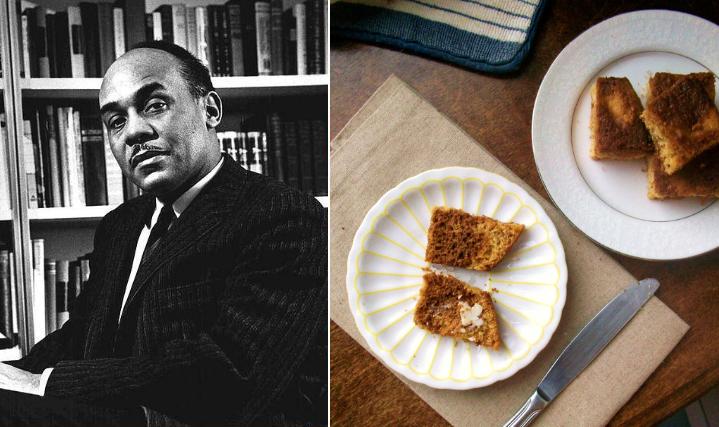
Ralph Ellison: Molasses Cornbread

There’s a scene in Ralph Ellison’s The Invisible Man that has become one of the most famous food passages in history. The unnamed narrator, passing a sweet-potato vendor on the road, is transported back to his childhood in the South, happily recalling meals of fried chicken and chitterlings – foods that soon became too racially charged for him to enjoy. But in this moment, the narrator is changed: He gets three orders of potato, newly determined to eat what he likes without shame. “I yam what I am,” he shouts, transformed (and if your mind went straight to Popeye, just remember what a dramatic effect food had on him).

Food unexpectedly changed the course of Ellison’s life: When he started studying music at the Tuskegee Institute, he also began working long hours in the dining hall, in order to pay off his tuition. You could find him on the early shift – 5 a.m. to 1 p.m. – baking cornbread and pouring bowls of molasses for the breakfast service. And after graduation, it was cooking – not music – that landed Ellison a job. Failing to score a coveted spot as a trumpeter in a military band, he instead found work as a cook on a Liberty ship, turning out versions of the Southern staples he learned at Tuskegee: cornbread, biscuits and fried pies.

It wasn’t until Ellison began traveling abroad, away from the Southern dishes that had defined his early years, that he realized how they had worked their way into his being. Living in Rome in 1956, Ellison wrote to his friend and fellow writer Albert Murray, “I got no way to get any corn bread … no sweet potatoes or yellow yams, a biscuit is unheard of – they think it means a cookie in this town – and their greens don’t taste like greens.”

Today fried chicken and stewed greens have gained gourmet cred – collard green risotto is totally a thing – but there will always be foods that feature guilt as a main ingredient. The phrase “you are what you eat” has become a grim warning, baking shame into things that ought to be enjoyed in moderation. We focus so much on the physical effects of our diet, it’s easy to forget that food can change us in other ways – ones that don’t involve calories or celery sticks but instead affect our minds and hearts: sweet potatoes for comfort, ice cream for renewal, chocolate for joy.

* * *

Continue reading “Ralph Ellison: Molasses Cornbread”

The Cocktail Hour: Robert Penn Warren

grapefruit gin punch cocktail recipe

“I had a birthday – only a few days ago – and am now thirty-eight,” wrote Robert Penn Warren in 1943. I’ve had birthdays on the brain, having also celebrated one recently. It wasn’t a big, round number, but it was a perfect square, the mathematics of which somehow seem especially daunting. It’s that age when we’re expected to put away childish things and start careers, find ourselves, tie the knot, settle down, paint the nursery, take out a mortgage. Instead of doing those things, I started this blog.

Clearly, a cocktail was in order. Luckily, Warren had just the thing.

Although it doesn’t have the universal significance of a 30th or a 40th, Warren’s 38th birthday was actually a very noteworthy one: It meant he could no longer be drafted into World War II. To celebrate, Warren threw “a gentlemen’s party with a particularly insidious punch” and invited his colleagues from the University of Minnesota, where he directed the creative writing program. If you think tenured professors don’t know how to party, think again: The revelry lasted almost seven hours, and they went through four gallons of punch.

If Warren’s parties were anything like his letters, they would have been a wickedly good time. Biding his time before At Heaven’s Gate to be published, he was full of writerly gossip, from who was a hack to who just got thrown in prison. He hates on the Chicago Tribune (“the world’s stinkingest paper but pays well”) and gives begrudging praise to The Nation (“doesn’t pay well but … is respectable”). August Strindberg and William Somerset Maugham? “Pure horse droppings.”

I can only imagine what bons mots Warren, on a little too much punch, might have dropped at his birthday shindig. He claimed that “high aesthetical conversation raged until a late hour,” but later dropped the act and just admitted the discussion was “more noise than wit, but the noise sounded like wit at the time.” It’s easy to take yourself too seriously as major birthdays loom, which might be why so many grown-ups have such dull parties. But Warren shows it doesn’t have to be that way. Just mix a group of good friends, a lot of noisy laughter, plus a glass of something delicious to wash it all down.

* * *

Robert Penn Warren grapefruit gin punch

Continue reading “The Cocktail Hour: Robert Penn Warren”

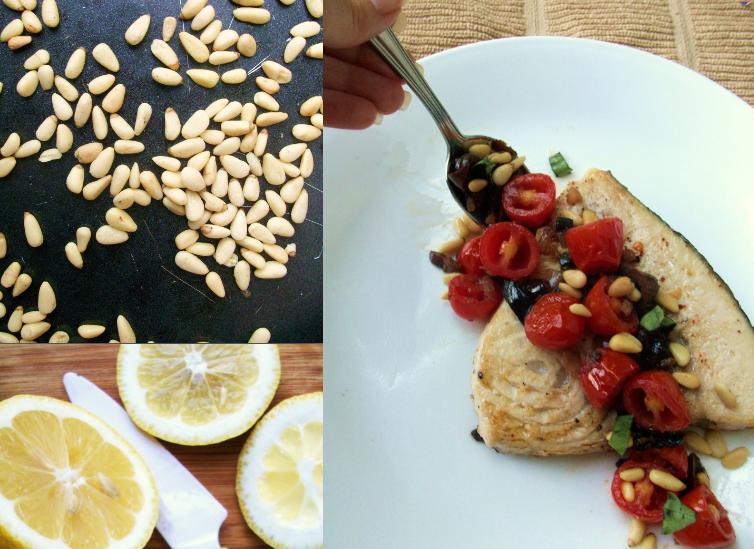
Raymond Chandler: Swordfish Siciliana

What to cook for Raymond Chandler on his birthday? If he’s known for anything vaguely digestible today, it’s Terry Lennox’s gin gimlet recipe from The Big Sleep: “half gin and half Rose’s lime juice and nothing else.” Sometimes that can be the basis of a whole birthday dinner menu, but it’s usually unintentional (and ill-advised, if my “popcorn and whiskey” birthday was any indication).

But it turns out Chandler had more than a few recipes up his sleeve – maybe even a cookbook’s worth. While working on The Long Goodbye in La Jolla, California, he wrote to editor Dale Warren with another surprising proposal. “Somebody really ought to write a cookbook and put in all the things that the regular cookbooks leave out, the things which, if you’re a beginner, the cookbooks don’t tell you,” he said. “Also, any decent cookbook should have a few special recipes, a touch of the unique. And this I could easily supply.”

Seen through his letters, Chandler becomes the Mark Bittman of La Jolla. He’s minimalist in his approach to food (his recipe for pork chops: “Cook them in their own fat, they bring everything with them that is necessary except salt and pepper.”). But he’s also deeply critical of Americans’ slide into non-cooking, 50 years ahead of the curve. He scorns his neighbor’s dependence on “a deep freeze unit in his garage where he keeps enough food for six months … Most of the other food he eats comes ready-prepared and half-chewed.” If you think that’s harsh, Chandler goes on: “I sometimes wonder what we are here for. Certainly not to use our minds.” It’s a relief he wasn’t around to see the rise of the Hot Pocket.

Chandler would have turned 124 today; I’ll celebrate my own birthday later this week. No popcorn and whiskey for me this time around. We’re older now, and wiser. We use our minds. We plan our menus. And there won’t be anything frozen or ready-made, although there may well be a gimlet or two.

* * *

Continue reading “Raymond Chandler: Swordfish Siciliana”

Wallace Stevens: Coconut Caramel Graham Cookies

If cookies were a literary genre, I suspect they’d be the romance novel. Neither one gets much respect in highbrow circles, but both have a dedicated, verging-on-rabid following. They’re the perfect accompaniment to a rainy Sunday afternoon – and it’s dangerously easy to consume several in one sitting.

But unlike romances, with their embossed and be-Fabio’ed covers, cookies aren’t winning any beauty contests. They’re usually not much to look at, which is one reason why they’re more often found in our home kitchens than on restaurant menus. They’re homely in every sense.

If you had met him on the street, you might have thought Wallace Stevens was similarly unremarkable. Every day for over 40 years, he got up, got dressed, and commuted to his achingly normal day job at a Connecticut insurance agency (Kafka also worked in insurance, which makes you wonder just what goes on over there). His humdrum evening routine consisted of eating a cookie while reading the paper. He didn’t publish his first poem until he was 35, and even after he won the Pulitzer, he still went to the office every day, and ate a cookie every night.

No other writer talks about cookies as much as Stevens does. Elsie, his wife, always seemed to have a batch baking; “I can almost smell them,” Stevens wrote in his letters. He brought them on picnics, and gave boxes of them away as Christmas gifts. Even Stevens’ daughter associated  with cookies; when he was away on business, she would put a cookie by his place at the table, waiting for him to come home.

Stories like that remind me why cookies, despite their homely status, are so beloved: They tie in to our most cherished memories, and remind us of those little moments that make life worth living. Stevens knew that power well. In 1948, after returning from a trip to New York with Elsie, he wrote, “We went into the kitchen, sat there drinking milk and eating cookies. … This is not much. Yet it is a little in spite of everything.”

* * *

Continue reading “Wallace Stevens: Coconut Caramel Graham Cookies”

Ernest Hemingway: Bacon-Wrapped Trout with Corn Cakes

Were you expecting a stiff cocktail? Fresh marlin? Braised wildebeest? Ernest Hemingway has become such a legendary character, it’s hard to think of a recipe that could match his macho reputation. It’s clear that the man loved food; A Moveable Feast is one of the most sincere odes to eating I’ve ever read. But did Hemingway cook?

Whether on a Cuban beach or the African savanna, Hem was a fan of the good life – and that included making good food. “It is all right to talk about roughing it in the woods. But the real woodsman is the man who can be really comfortable in the bush,” he wrote in an essay on camping for the Toronto Star.  As a kid, Hemingway spent many summers hiking through Michigan, and his ideal meal was a freshly caught fish. But most of his fellow outdoorsmen didn’t know their way around a griddle. “The rock that wrecks most camping trips is cooking,” he griped. “The average tyro’s idea of cooking is to fry everything and fry it good and plenty.”

As a solution, he proposed a simple but satisfying meal for any campfire cook. Trout was a favorite for Michigan fishermen, but it can dry out easily. So Hemingway suggested cooking it in layers of bacon, whose fat bastes the fish as it renders. “If there is anything better than that combination the writer has yet to taste it in a lifetime devoted largely and studiously to eating.”

Of course, sometimes the hardest part of cooking isn’t preparing the meal itself – it’s waiting for it to be done. Hemingway saw that coming, too. He recommended whipping up a batch of pancakes to serve before the main course, to satisfy any unhappy campers.

* * *

Continue reading “Ernest Hemingway: Bacon-Wrapped Trout with Corn Cakes”

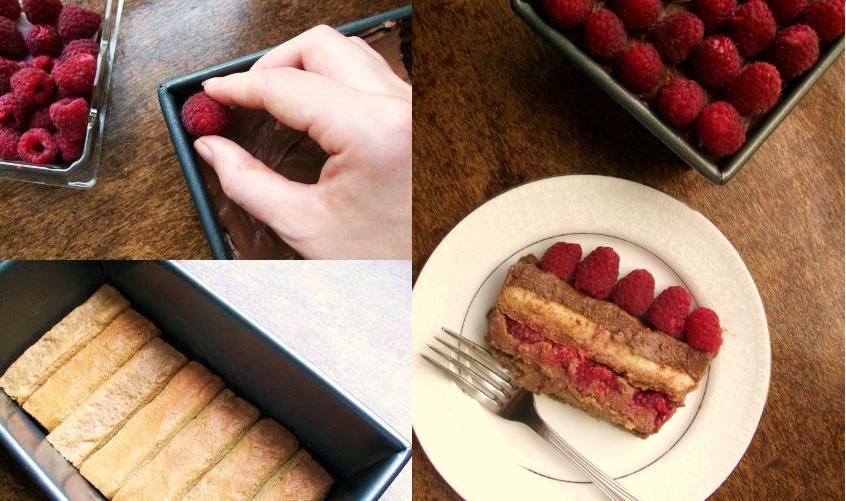
Truman Capote: Italian Summer Pudding

How long can you last before thinking about what to cook for dinner? It’s a rare occasion when I make it past lunch. Usually by my morning commute, I’m already gone – dreaming up recipes as I walk to the subway, devising shopping lists at lunch, dropping by the farmers’ market on the way home. So I know how Truman Capote felt when he wrote: “Food. I seldom think of anything else.” That kind of sums it all up, doesn’t it?

I’ve always loved eating food, but it wasn’t until I moved to New York—and had a kitchen to myself—that I began to love cooking it. If an aspiring writer needs a room of her own, a budding chef needs a kitchen: a private laboratory where she can experiment to her heart’s (and stomach’s) content. Capote’s chance came in 1950, when he settled down in Sicily with his partner Jack Dunphy. Capote always had a personal cook, but in Sicily he began to explore the kitchen himself – “an unmanly activity, I suppose, but very relaxing and the reward is delicious,” he wrote after a day making fruit preserves. Plus, he noted, storing jam was great way to “do something with these old gin and wine bottles,” a tip destined for the Pinterest boards of boozehounds everywhere.

What began as a way to pass the time became a food obsession, with a particular focus on sweets. After graduating from humble Toll House cookies to fancy chocolate confections, Capote ultimately took on the amateur cook’s triathlon: For Christmas in 1951, he presented Dunphy with a turkey, chestnut stuffing, and a multilayer orange almond cake.

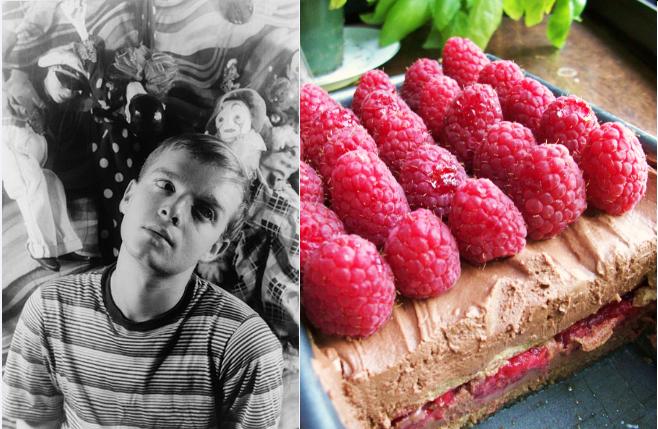
Despite his new culinary chops, though, Capote’s favorite treat was something he didn’t make. In 1962, on a trip to England, he and his friend Cecil Beaton lunched with the Queen Mother. But the royal company didn’t impress Capote – the dessert did. It was “the best cake I’ve ever tasted – a sort of chocolate cream stuffed with fresh raspberries,” he wrote. He wasn’t shy about expressing his enthusiasm, either; years later, Beaton remembered his friend cheering with joy when it was served. Because when a good dessert is involved, who can be bothered with a stiff upper lip?

* * *

Continue reading “Truman Capote: Italian Summer Pudding”

Jack London: Bacon and Tomato Baked Risotto

On any cookbook shelf, stashed between the glossy covers and the celebrity chefs, there are always a few oddities. Maybe it’s the book you picked up from the giveaway pile at the library. Maybe it’s the gift your friend got you as a tragic joke. But my favorite finds in any collection are the community cookbooks: those spiral bound, DIY collections that bring together the favorite recipes of a group of friends.

Today it’s all about Kickstarter, but community cookbooks used to be a key fundraising tool: Throw in a few bucks for a cause, and you’d get enough recipes to last you the month (plus a tempting window into your neighbors’ kitchens). And one of the first groups to make use of the idea was the women’s suffrage movement. For the suffragettes, creating a cookbook was not only a savvy business move, it also helped counter women’s fears that voting was too radical, too masculine. Donating to a political cause can seem a little daunting. But buying a cookbook? That’s just good taste.

So where does a man’s man like Jack London fit in? Ever the outdoorsman, London was building a sustainable ranch in California when he met the writer Charlotte Perkins Gilman, a vocal supporter of the women’s suffrage movement. The two shared an interest in socialism, and soon London began to appear at Gilman’s suffrage rallies. When the Equal Franchise Federation of Western Pennsylvania was seeking recipes for The Suffrage Cook Book in 1915, London pitched in with a few of his “especial ‘tried’ favorites.”

London died a year after the cookbook’s publication, three years before women’s suffrage became a reality in 1920. Whether he was genuinely interested in the cause is up for debate – pushing for a ban on alcohol, he noted that when “the ladies get the ballot, they are going to vote for prohibition.” But to readers of the cookbook, London wasn’t a prohibition crusader, or even a big-name author. He was just a fellow activist – who happened to make a mean risotto.

* * *

Continue reading “Jack London: Bacon and Tomato Baked Risotto”

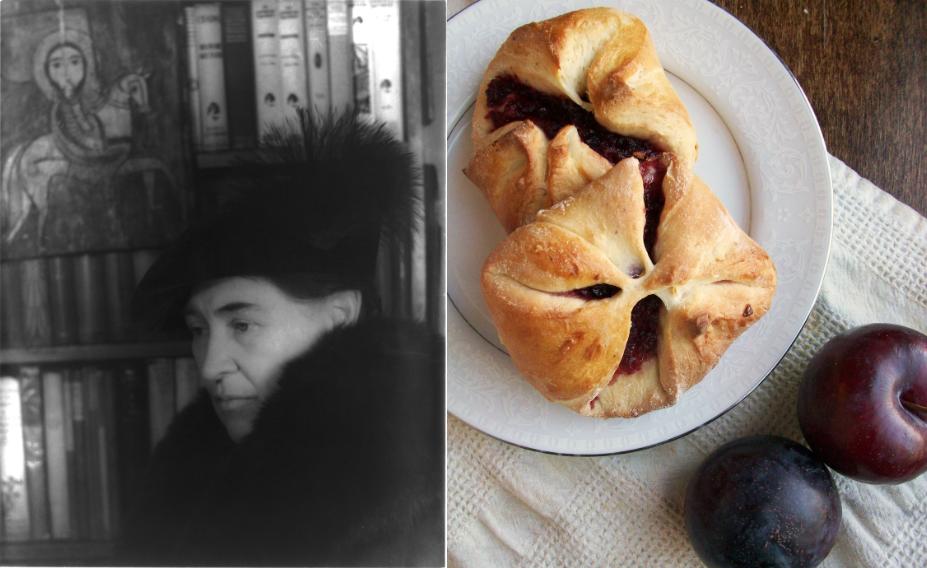
Willa Cather: Spiced Plum Kolache

Willa Cather - Spiced Plum Kolache

Two months ago, if you had asked me to describe Willa Cather, I would have pictured her writing in the middle of the Nebraska farmland, surrounded by as many sheaves of paper as sheaves of wheat. I didn’t realize that, when she was 23, Cather left the Great Plains for the big city; she moved to Pittsburgh and then to New York, where she lived for the rest of her life. She didn’t publish her first novel until 16 years after the move, when Fifth Avenue must have been just as familiar as the farm.

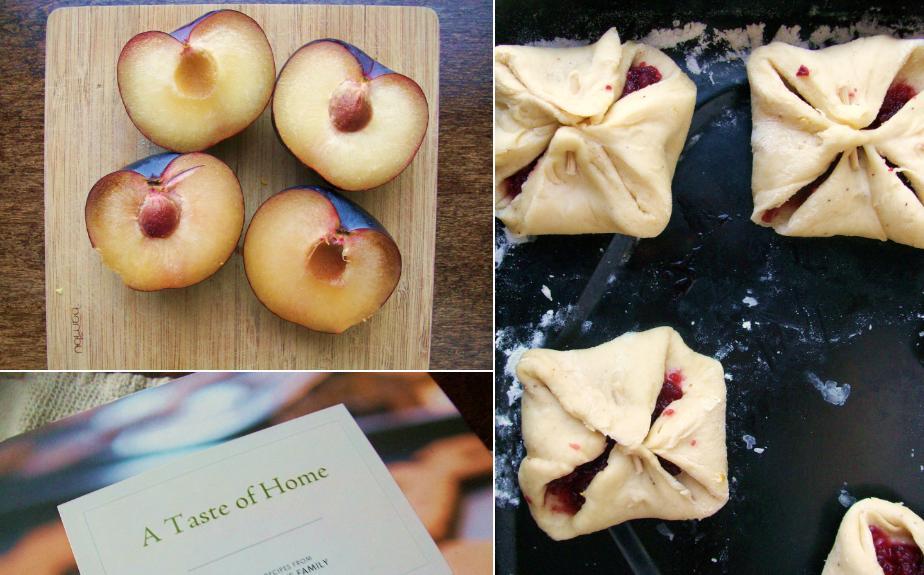
It’s no wonder, then, that food played such a major role in Cather’s writings: She needed it to bring her back to life on the frontier. With their incredible power to conjure up a time and place, food memories are some of the strongest associations around. More than anything else about a trip, I remember the meals: crabs in Baltimore, étouffée in New Orleans, pain au chocolat in Paris. When I left home in California for the unknowns of the East Coast, my mom sent me off with a bound compilation of our family’s favorite recipes. Seven years later, in my New York kitchen, I still flip it open when deciding what to make for dinner. It’s one of the best gifts I’ve ever gotten.

In Nebraska, Cather drew her cooking inspiration from Annie Pavelka, a Bohemian immigrant to the town of Red Cloud whose life (and food) would serve as the basis for My Ántonia. In her own New York kitchen, hundreds of miles from home, I imagine Cather consulting her recipes and rolling out her pastry dough like Annie did,  mentally recreating the pioneer communities of her childhood.

* * *

In Progress - Spiced Plum Kolache

Continue reading “Willa Cather: Spiced Plum Kolache”