Gabriel García Márquez: Lobster Tail with Spaghetti and Bread Crumbs

In the pantheon of great literary friendships – Kerouac and Ginsberg, Emerson and Thoreau – Gabriel García Márquez and Fidel Castro isn’t a wildly popular pair. What does the master of magical realism have to chat about with the Cuban president? And who said Castro is literary, anyway?

Well … Márquez did. “It may not be widely known that Fidel is a very cultured man,” he told Playboy. “When we’re together, we talk a great deal about literature.” And when they met for the first time in 1977, Castro and Márquez discovered another shared bond: They were both seafood fiends. What began as a diplomatic exchange about Angola turned into a lengthy conversation about lobster recipes. The same thing happens when my family starts talking politics at the table; we end up retreating to a common ground and asking what’s for dessert.

It was the beginning of a culinary kinship. Over the next few years, they rhapsodized over shrimp. Their dinner menus were odes to the sea. When a Cuban chef who frequently cooked for the high-powered pair published a book, he included the recipes he associated with them: turtle soup for Castro, and lobster for Gabo.

Although Castro’s fondness for spaghetti threatened to eclipse his shellfish infatuation (“Fidel is still doing spaghetti,” Márquez sighed in an article in 1985), he knew what he wanted where seafood was concerned. “It’s best not to boil shrimp and lobsters, because the boiling water weakens the substance and flavor and makes the meat a little bit tough. I like to broil them in the oven or grill them. … For condiments, just butter garlic and lemon. Good food is simple food.”

* * *

Continue reading “Gabriel García Márquez: Lobster Tail with Spaghetti and Bread Crumbs”
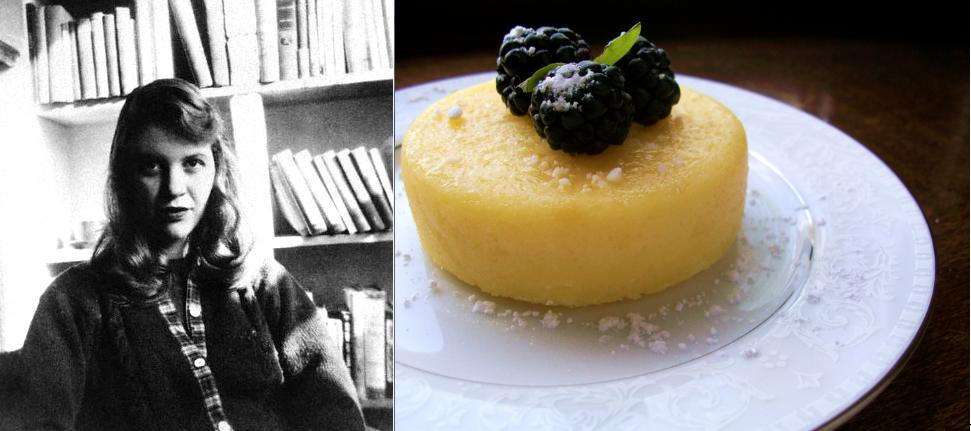
Sylvia Plath: Lemon Pudding Cakes

Is it taboo to write about baking and Sylvia Plath? When I told a friend what I was cooking this week, his face froze in a half-smile. “Oh, um, ha! But really, what are you making?” Another awkward reaction: “Well … be careful?”

I still feel like I’m tiptoeing around the elephant in the room every time I mention an oven. But, as for many a 1950s-era wife and mother, cooking and baking were large parts of Plath’s daily life, and not unwelcome ones. “How I love to cook!” she wrote in her journals – and apparently she was no slouch either. Ted Hughes praised his wife’s cooking in his letters: “Sylvia by the way is becoming the most superlative cook I’ve encountered.” To him, she was “a princess of cooks.”

We tend to think of cooking, and particularly baking, as a soothing, cathartic experience. But, as anyone who has put together a dinner party (much less run an actual bakery) can attest, it can lead to some very un-soothing thoughts. Did I beat the eggs enough? Shouldn’t it be rising more? What if I didn’t grease the ramekins enough and half of the cake sticks and then it breaks in half and the whole thing is ruined and then what will I do? THEN WHAT?

Plath seemed to have a similar dual reaction to her time in the kitchen; it was both a blessed release and a warning sign, a suffocating dead end. In 1957, after a day spent baking a pie, Plath worriedly wrote in her journal, “You will escape into domesticity & stifle yourself by falling headfirst into a bowl of cookie batter.” It’s an uncomfortable moment, a hint of things to come.

* * *

Sylvia Plath Lemon Pudding Cake

Continue reading “Sylvia Plath: Lemon Pudding Cakes”

John Steinbeck: Pork Posole

John Steinbeck was a locavore before it was cool. No matter where he was writing from, his letters always mention the local produce. In California, he bought a cow so he could make his own butter and cheese. In England, he foraged for dandelion greens (“cook them slowly and for a long time with pieces of bacon”). In Sag Harbor, he reveled in the local seafood (“I figure I can always catch my dinner”).

But sometimes you come home after a long day, and you don’t want to knead your own bread, dry your own pasta, butcher your own goat. You just want to buy a whole baguette, put some brie on it, eat it all while watching The Wire on Netflix and call that dinner. “I like good food and good clothes, but faced with getting them I can’t round myself into a procuring unit,” Steinbeck wrote in a particularly lethargic mood. I imagine he said it on the sofa in sweatpants.

Often it’s the presence of other people that keeps me from nights of cheese sandwiches in front of the TV; cooking for company is just more fun! But when Steinbeck was alone on the road, he would forget the butter-churning and revert to the life of a single guy. Hence his recipe for posole, borrowed from his friend (and famed screenwriter) Jack Wagner: “a can of chili and a can of hominy.” Hello, bachelorville.

* * *

Continue reading “John Steinbeck: Pork Posole”

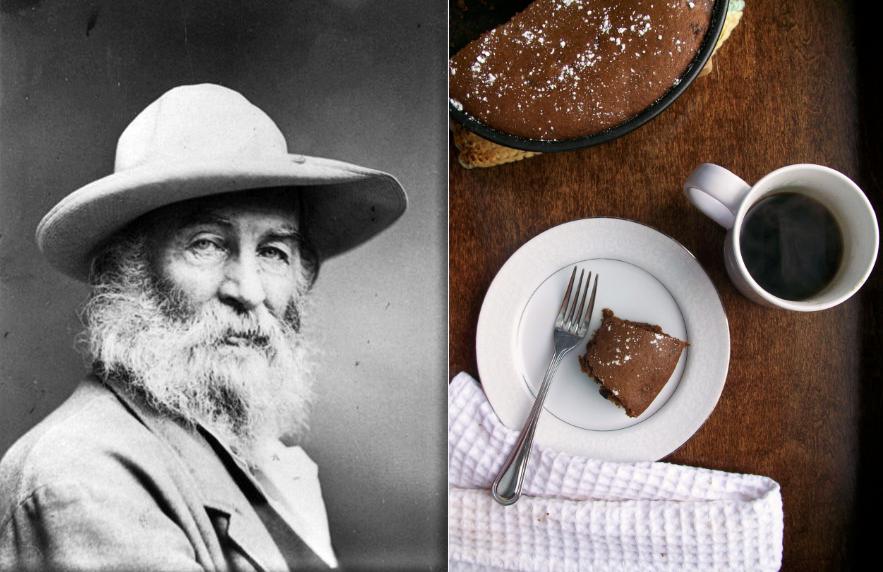
Walt Whitman: Cranberry Coffee Cake

For a transcendentalist, Walt Whitman was a bit of a hoarder. Just take a look at his daybooks, and you’ll see a list of the scraps he saved over the years: photos, receipts, weather reports, news articles, classified ads, and dozens of press mentions of Whitman himself. He meticulously monitored the papers, carefully cataloging his presence in the world. If he were around today, you just know he would be a chronic self-Googler, or maybe a habitual lurker in the comments section of New York magazine.

Among Whitman’s collection of papers from the 1880s are the few recipes he liked enough to preserve: one for doughnuts and one for coffee cake, making him a man after my own (pastry-clogged) heart. He regularly gave coffee cakes as gifts, probably because he wanted to receive them himself. In a letter from 1877, he wrote, “I was foolish enough to take a good strong drink, & eat a couple of slices of rich cake late at night – & I shan’t do any thing of the kind again.” Yeah, I’ve heard that one before. It’s what I tell myself before checking to see if the ice cream place down the street delivers (the beauty of New York is that it does).

That year, Whitman was recovering from a stroke and had moved to New Jersey under the care of his brother. “But I am pretty well,” he wrote, “& feel more able & sassy every day.” More than anything in Leaves of Grass, these letters from Whitman have inspired my new personal philosophy: Live every day with sass, and with several slices of cake.

* * *

Continue reading “Walt Whitman: Cranberry Coffee Cake”

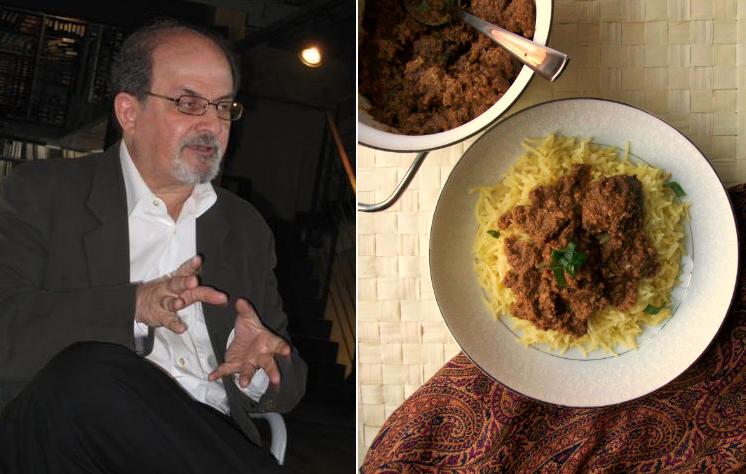
Salman Rushdie: Lamb Korma

You can’t escape food when reading Salman Rushdie. Start looking and suddenly it’s everywhere: Pyarelal’s saffron pulao in Shalimar the Clown, Sisodia’s feast in The Satanic Verses, the grandmother’s pantry in Midnight’s Children.

It’s the same with the real Rushdie; he’s a man surrounded by food. His marriage to Top Chef and cookbook author Padma Lakshmi is an obvious connection. But so is his involvement with At Vermilion, the Manhattan restaurant that once offered a tasting menu devoted to his work (complete with autographed novel to take home, goodie bag style). You think you’re reading an article about the fatwa and boom —out of the blue, it links to the author’s recipe for curry. Food just follows him.

Why Rushdie decided to give Parade magazine his korma recipe, I’ll never know (it doesn’t quite jibe with other articles on offer: “Fire Up the Griddle! Pancakes for Every Meal of the Day”). But his description of the family history behind the dish (it’s his son’s favorite as well) reminds me why food plays such a crucial role in his novels: Community comes together over a good meal.

Korma was a favorite dish in Midnight’s Children, too, but in a less heartwarming, more threatening context. “This, whatsitsname, is a very heavy pot,” that grandmother says, “and if just once I catch you in here, whatsitsname, I’ll push your head into it, add some dahi, and make, whatsitsname, a korma.” I decided to go with Rushdie’s version of the recipe instead – more lamb, less dismemberment.

* * *

Continue reading “Salman Rushdie: Lamb Korma”

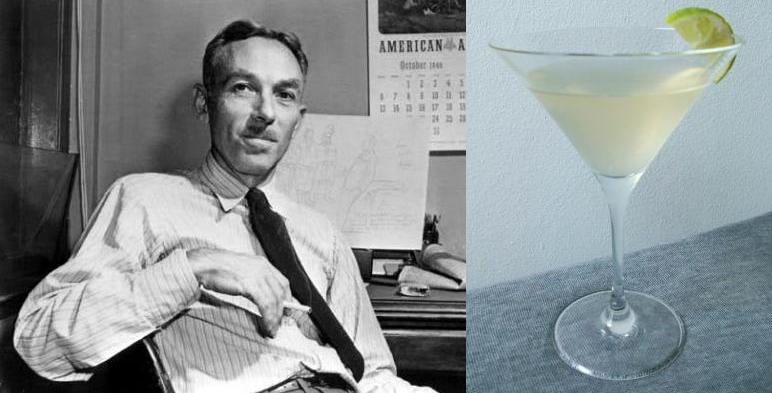
The Cocktail Hour: E.B. White

Learning about the drinking habits of your favorite children’s book author is both disconcerting and a little thrilling. It’s like that teenage realization, so obvious yet somehow inconceivable, that your parents likely were sloshed at some point during your early years and you didn’t even notice.

When you’re raised with Charlotte and Stuart Little, it’s harder to remember E.B. White’s other pursuits, ones that make him a more likely candidate to kick off a cocktail feature. Besides revising that English-major staple The Elements of Style, he was one of The New Yorker’s top contributors for an incredible 50 years. After a half-century in that crowd, you’re bound to pick up a few mixology tricks.

Writers are a notoriously well-soused bunch. But a martini probably has the most literary pedigree of any drink in the repertoire: the publishers’ three-martini lunch, Dorothy Parker’s poem, James Bond. White was one of its most vocal devotees, praising it as “the elixir of quietude. … Martinis, if anything, have a muting effect on the constant ringing in my ears.”

It’s still hard for me to picture White, martini glass in hand, writing the words I would later read with a flashlight under the covers. It’s easier to imagine him early on: just out of Cornell and working at an ad agency, looking for a newspaper job on his lunch breaks. “I wouldn’t mind going without the food if I could have a little luck with the jobs, but it’s damn hard to have neither success nor sandwiches at noon,” he wrote in 1921. When his first New Yorker piece was published, four years later, I envision him sitting down with a celebratory turkey club and pouring out a much-deserved drink.

* *  *

Continue reading “The Cocktail Hour: E.B. White”

Charles Dickens: Apples à la Princesse

Thinking of Dickensian food conjures up two extremes – the stuffed goose and figgy pudding feast of A Christmas Carol and the sad gruel rations of Oliver Twist. During Dickens’ 200th birthday celebrations this month, there was a lot of talk of the former. Nobody seemed as excited about the gruel, but there are plenty of resources to help you make an authentic Victorian version that actually sounds kind of great (Favorite BBC quote: “We were hoping he’d make it far more disgusting.”)

Given the fame that Dickens achieved in his lifetime, he didn’t have to beg for second helpings. But one of his favorite dishes, baked apples, was quite simple, not to mention practical: He swore by their ability to prevent seasickness.

Dickens became a baked apple convert while sailing to Boston in 1867. They were served at every meal during the Atlantic crossing, and he always helped himself. “I am confident that they did wonders, not only at the time, but in stopping the imaginary pitching and rolling after the voyage is over,” he wrote to his sister-in-law, Georgina Hogarth.

The magical apple diet clearly made an impression, and in 1881 Charles Dickens Jr. dedicated an entire cookery column to them in Household Words, a revived version of his father’s weekly magazine. Apples were getting cheaper and were beginning to be imported from abroad, so baked apples could be made by anyone, anytime. Perhaps thinking of his father, Dickens Jr. stressed the health benefits of the fruit. “It is unnecessary to say how valuable apples are as an article of diet.” Turns out, Dickens had been on the edge of a trend: The earliest version of our famous “An apple a day” saying was first published in Wales in 1866, just a year before his trip to the States.

* * *

Continue reading “Charles Dickens: Apples à la Princesse”

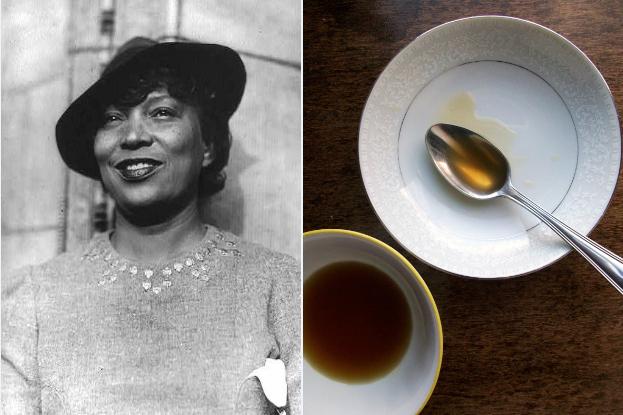
Zora Neale Hurston: Chicken Consommé

“So, what’s your backup plan?”

Everyone who lusts after a job in some creative field runs into this inevitable question. When I was 10, I told my mother I was destined for Broadway. When pressed for a possible fallback, I shrugged and said I could always go into journalism. She has worried about me ever since.

In the fall of 1931, Zora Neale Hurston was working on several projects, all of them artsy and none of them lucrative: short stories, concerts, book proposals. Recently divorced and without a steady income, she was being supported by her godmother, the philanthropist and New York socialite Charlotte Osgoode Mason. Mason and my mother would have had a lot to talk about. “I know that you worry about my future,” Hurston wrote to her godmother. “Therefore, if I had a paying business—which after all could not take up a great deal of my time,—I’d cease to be a problem.”

That’s how she came up with her backup plan to become “New York’s Chicken Specialist.”

Like any good start-up entrepreneur, Hurston did her research. She surveyed the local competition: “I have been sampling the chicken soups already on the market and find not one really fine one.” She outlined the business model: Ever practical, she would use all parts of the bird. The bones would be for soup. The chicken breasts, “they’d be my salad material. The other part of the chicken would emerge as a la king.”

But despite her concessions toward her godmother and her own pragmatism, Hurston never wavered in her assurance about her real talent. “I firmly believe that I shall succeed as a writer, but the time element is important,” she wrote to Mason. “Besides I like to cook.”

* * *

Continue reading “Zora Neale Hurston: Chicken Consommé”

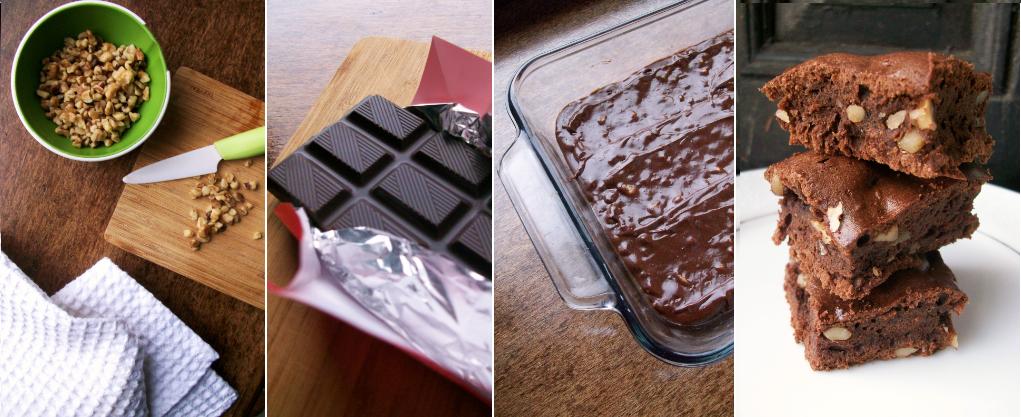
Elizabeth Bishop: The Brownie Recipe

Baking, especially baking bread, is one of those activities that is perennially nerdy-cool, like knitting or discussing artisan teas. If you’ve ever talked with rhapsodic satisfaction about your sourdough starter, you’re a part of it. But you’re not the first.

Elizabeth Bishop was one of the earliest to recognize the proto-hipster qualities of baking from scratch, after the 1920s inventions of Betty Crocker mixes and Wonder Bread made it unnecessary. “My part-time work at present seems to be baking bread,” she wrote to Robert Lowell in 1960, adding presciently, “it sounds food-faddish I’m afraid.”

Although she was always an occasional baker, making treats for cake sales and birthdays, it wasn’t until landing in Brazil in 1951 that Bishop made it a habit. Her trip, which began as a travel fellowship, turned into a 15-year stay, and she soon became a very popular neighbor thanks to one of her signature recipes: brownies.

The earliest published recipes for brownies appeared in Chicago and New England the early 1900s, but according to Bishop they hadn’t made it to South America by the 1950s. Her version was an instant hit. “Since Brazilians are mad about anything chocolate … I have been requested to bring along 4 dozen brownies (something I’ve introduced to Brazil) and a large chocolate cake,” she writes to Lowell in the fall of 1957. “You see how innocent our lives are here—just making money and eating sweets.”

There’s an intimacy about baking, which might be why I always like to celebrate Valentine’s Day with homemade desserts. But reading from the correspondence between Bishop and Lowell is just as romantic to me – no bodice-ripping, but plenty of wit, flirtation, and the kind of tenderness that bespeaks a very deep love.

* * *

Continue reading “Elizabeth Bishop: The Brownie Recipe”

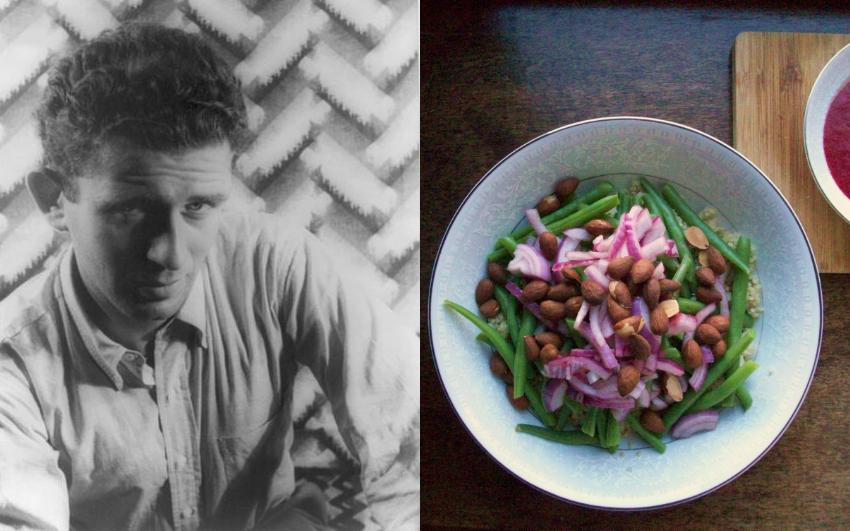
Norman Mailer: Green Bean Salad with Raspberry Vinaigrette

In his famous appearance on The Dick Cavett Show, after headbutting Gore Vidal backstage, Norman Mailer humbly referred to himself as a “dizzying intellect.” I’ll leave that literary debate to his critics, but at least in the kitchen, Mailer was a thinker.

In his semi-recent memoir, Dwayne Raymond discusses his firsthand experience with the giant brain; he helped research Mailer’s last novel, The Castle in the Forest, but also served as confidant, tech support, chef, and guinea pig for some of Mailer’s more unique food creations.

Mailer theorized on food like a man obsessed. Occasionally this would manifest itself in more compulsive ways, like meticulously cutting a grapefruit in exactly nine sections. But you could see it more often in his pursuit of the culinary Shangri-La: a recipe that would maximize flavor, nutrition, and integrity of the ingredients all in one.

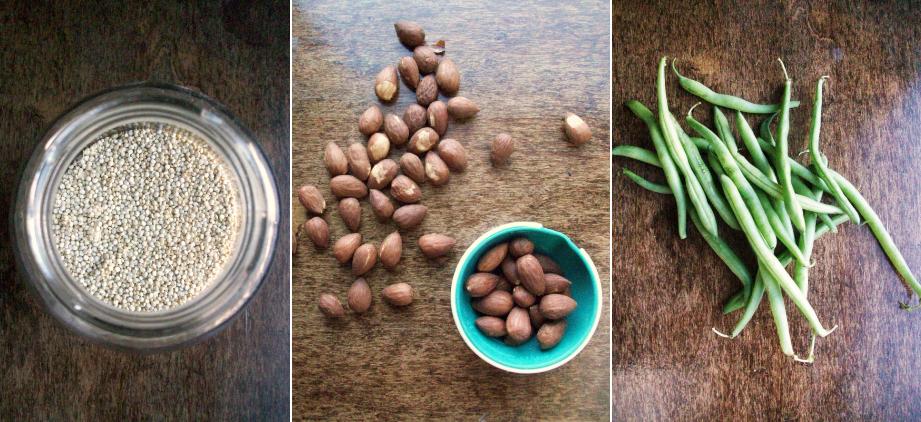
Not that these concoctions were necessarily successful. Case in point: a ghasty-sounding salad made of green beans and teriyaki-infused oatmeal (to lower cholesterol). Another “experimental” salad recipe involved the addition of Häagen-Dazs Raspberry Sorbet to a vinaigrette. “It didn’t occur to him that the whole concept was dreadful; that wasn’t the way his mind worked,” Raymond writes. “Norman believed that anything awful could be fixed if enough work was put into it.”

In that spirit, I decided to take on an awful-yet-fixable dish. Re-enter the green bean and oatmeal salad.

* * *

Continue reading “Norman Mailer: Green Bean Salad with Raspberry Vinaigrette”