
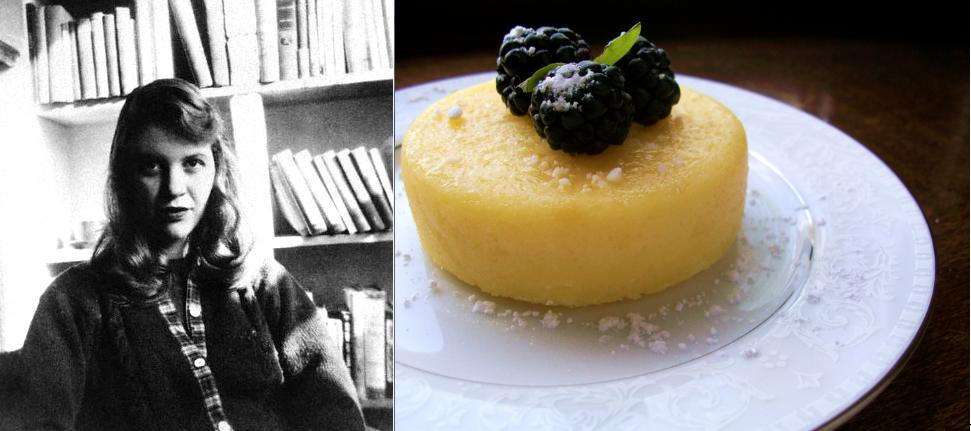
Is it taboo to write about baking and Sylvia Plath? When I told a friend what I was cooking this week, his face froze in a half-smile. “Oh, um, ha! But really, what are you making?” Another awkward reaction: “Well … be careful?”
I still feel like I’m tiptoeing around the elephant in the room every time I mention an oven. But, as for many a 1950s-era wife and mother, cooking and baking were large parts of Plath’s daily life, and not unwelcome ones. “How I love to cook!” she wrote in her journals – and apparently she was no slouch either. Ted Hughes praised his wife’s cooking in his letters: “Sylvia by the way is becoming the most superlative cook I’ve encountered.” To him, she was “a princess of cooks.”
We tend to think of cooking, and particularly baking, as a soothing, cathartic experience. But, as anyone who has put together a dinner party (much less run an actual bakery) can attest, it can lead to some very un-soothing thoughts. Did I beat the eggs enough? Shouldn’t it be rising more? What if I didn’t grease the ramekins enough and half of the cake sticks and then it breaks in half and the whole thing is ruined and then what will I do? THEN WHAT?
Plath seemed to have a similar dual reaction to her time in the kitchen; it was both a blessed release and a warning sign, a suffocating dead end. In 1957, after a day spent baking a pie, Plath worriedly wrote in her journal, “You will escape into domesticity & stifle yourself by falling headfirst into a bowl of cookie batter.” It’s an uncomfortable moment, a hint of things to come.
* * *

 Paper and Salt