James Joyce: Rigatoni Con Stracotto

James Joyce - Rigatoni con Stracatto

I read Ulysses in my first year of college, armed with a “European Literary Tradition” class syllabus and a book of annotations that was nearly as long as the novel itself. The details of Proteus and Stephen Dedalus didn’t stay with me in the least, but what remained was the overwhelming sense of loneliness I felt: People were always sadly eating kidneys in a pub, a kind of dual gastronomic punishment (first the solitude, then the kidneys). For a generation that’s been told we should never eat alone, Leopold Bloom’s day seems like a cautionary tale (an extremely elaborate one).

Restaurants can be a taunt to the solitary diner: You can’t even be alone with your loneliness when there’s a table of strangers at your elbow. And your pity party of one would have felt particularly grim if you were seated next to James Joyce’s party of ten. When the Joyces went out, they went as a pack—a boisterous one. Hemingway shared the gossip from Paris in his letters: “[Joyce] and all his family are starving but you can find the whole celtic crew of them every night in Michaud’s, where Binney and I can only afford to go about once a week.” I picture a modern-day Joyce dining out, making it rain euros while ordering bottle service.

Joyce’s enjoyment of food, unlike that of his withdrawn characters, was wrapped up in his enjoyment of others, and vice versa. Writing to his brother, Stanislaus, he requested both food and company: “a slice of corned beef and cabbage, a sizeable beefsteak prepared on a gridiron, and (excuse the hierarchy) an intelligent supra-burgher like yourself to share the meal.”

But Joyce’s favorite dining companion was his wife, Nora—who conveniently also did all the cooking. A day with the Joyces meant a day of eating, starting with hot chocolate at 9 a.m. “At midday we have lunch which we (or rather she) buys, cooks (soup, meat, potatoes and something else)…. At four o’clock we have chocolate and at eight o’clock dinner which Nora cooks.” If anyone tells you having multiple hot chocolates a day is wrong, direct them here. 

Eating wasn’t all that went on in the Joyce’s kitchen; if you read their infamously naughty correspondence, you might not want to eat off their dining table when you learn where it’s been. But their exploits prove what Joyce clearly already knew: The kitchen isn’t just a place for the stomach, but for the heart. As he writes to Nora, after a short absence, “I shall not quit the kitchen for a whole week after I arrive, reading, lolling, smoking, and watching you get ready the meals and talking, talking, talking, talking to you. O how supremely happy I shall be! God in heaven, I shall be happy there!”

Rigatoni con Stracatto Recipe

Continue reading “James Joyce: Rigatoni Con Stracotto”

F. Scott Fitzgerald: Prohibition Ale

F. Scott Fitzgerald - Prohibition Ale

With the internet awash in Gatsby-themed gin rickey and mint julep recipes, F. Scott Fitzgerald has recently reasserted his reputation as “America’s Drunkest Writer.” It might seem like a dubious distinction, but Fitzgerald embraced boozing as a literary badge of honor (after all, he had to overcome some stiff competition for the title). He famously dubbed drink “the writer’s vice,” introducing himself at parties as “F. Scott Fitzgerald, the well-known alcoholic” or (when feeling particularly loquacious) “one of the most notorious drinkers of the younger generation.”

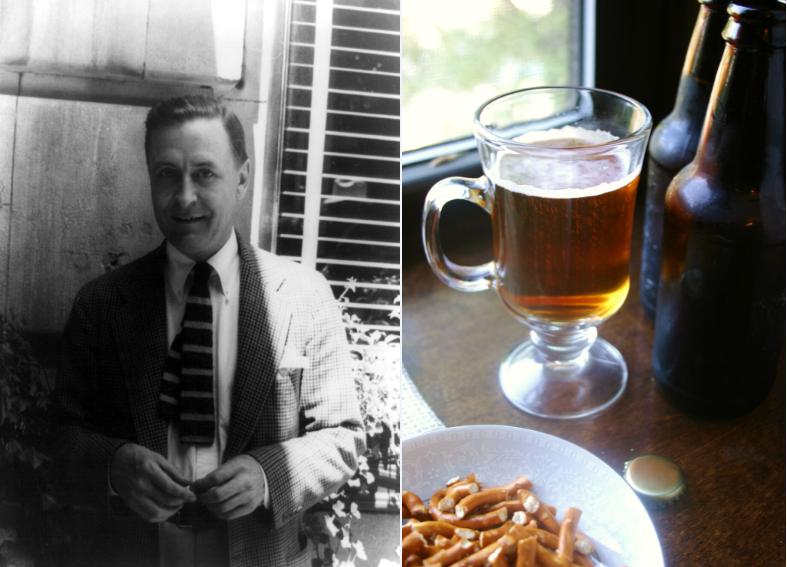
Gin has gone down in history as Fitzgerald’s particular drink of choice (he thought it would be harder to detect on his breath). But while gin was mainly for parties, beer was for every other time of day … including breakfast. It wasn’t a writer’s vice. It was his lifestyle.

When Zelda wrote to Scott in 1930, reminiscing about their early days back in New York, her memories were shaped by the beer they had shared. “We drank Bass Pale Ale,” she wrote. “We drank always.” It was after they moved to Europe that the Fitzgeralds started fueling their revels with hard liquor; good ales and lagers were hard to get in France, although Fitzgerald was pleased to encounter some decent brews on a visit to Germany in 1925.  He marveled at the wealth of “Pilsen and Munich beer of fine quality,” noting, “There is less than there was when I got here.”

When Fitzgerald returned to the U.S., he also returned to beer, his first love—a relationship that continued to carry him as his marriage to Zelda broke down. At his peak intake, he went through 37 bottles a day, using beer as a substitute for water (and if we were all that hydrated, our doctors would be so proud). To Scott, beer didn’t count as a real drink—just like when I was a “vegetarian,” fish didn’t count as real meat. In 1937, when Fitz claims to be “on the complete wagon,” he has to clarify: This time he means “not even beer.”

In the late 1930s, Fitzgerald tried to curb his intake of the beverage that had shaped his life: “I havn’t [sic] even had a glass of beer for a month + shall try it again,” he wrote. But even as he saw its impact on his health, he couldn’t help but indulge in a cold one every now and then. “The fact that I have abused liquor is something to be paid for with suffering and death perhaps,” he wrote, “but not renunciation.”

* * *

Prohibition Ale Recipe

Continue reading “F. Scott Fitzgerald: Prohibition Ale”

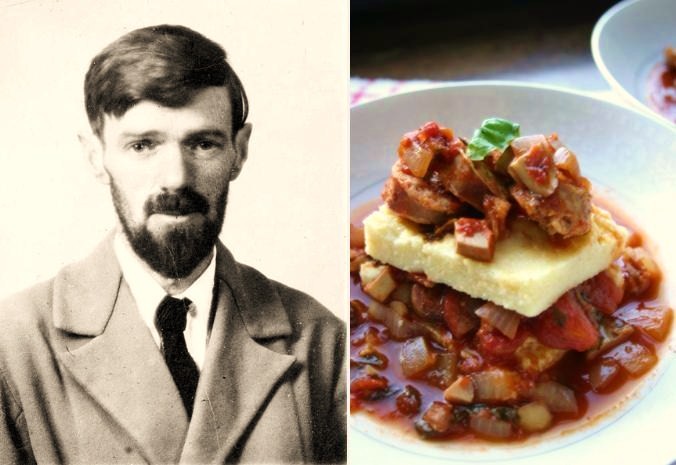
D.H. Lawrence: Polenta with Sausage Ragù

D.H. Lawrence - Polenta with Sausage Ragu

One hundred years ago, D.H. Lawrence was awaiting the publication of what would become his most famous (and most controversial) novel. Sons and Lovers celebrates its centennial this May—but in the weeks leading up to its release, Lawrence’s thoughts were elsewhere, in a little house across the Alps: “I want to go back to Italy,” he wrote.

Lawrence made his first trip to Italy while working on Sons and Lovers, and he felt an immediate connection. “I think I shall be happy there, and do some good work,” he said in 1912, just before settling near Lago di Garda, a few miles from Verona. Several months later, his writing was already moving along. “I do my novel well, I’m sure. It’s half done.”

But when taking a break from his desk, Lawrence was at work in the kitchen, which he praised in letters home. “There’s a great open fireplace, then two little things called fornelli – charcoal braziers – and we’ve got lots of lovely copper pans, so bright. Then I light the fornello and we cook. It’s an unending joy.” He found beauty in the smallest act of cooking—he loved his pots so much, he made sketches of them. Everything is just red earthenware, roughly glazed, and one can cook in them beautifully.”

For Lawrence, Italian cuisine meant a chance to experiment with ingredients of all kinds, from the quotidian to the obscure. “We eat spaghetti and risotto and so on all of our own making,” he wrote. “We eat quantities of soup … midday polenta made of maize flour boiled to a stiff porridge that one cuts in slices with a string … queer vegetables – cardi – like thistle stalks, very good – and heaps of fresh sardines.” He frowned upon the tendency of the locals to use too much oil, but had certain indulgences of his own: “Maggi and I grate pounds of cheese,” he admitted. 

If we’re lucky, we discover for ourselves what Lawrence found in Italy: that place that inspires all our creative pursuits, whether it’s at the desk or at the stove. The freedom and adventure he felt there, through, dissipated when he left Italy to go north. “I have suffered from the tightness, the domesticity of Germany. It is our domesticity which leads to our conformity, which chokes us.” Little did he know how non-conformist his new novel would be seen—a little reminder of Italy that lingered there. 

* * *

Polenta with sausage and mushroom ragu recipe

Continue reading “D.H. Lawrence: Polenta with Sausage Ragù”

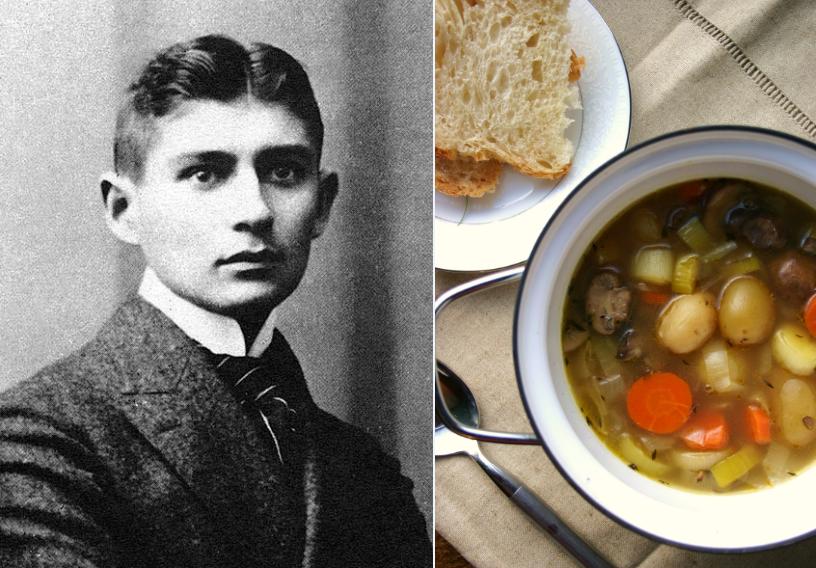
Franz Kafka: Potato Mushroom Soup

Franz Kafka - Potato Mushroom Soup

Another year, another fad diet. Every January, we’re told to go Paleo, go South Beach, go Atkins. It’s a culinary labyrinth that has existed for centuries—and Franz Kafka was an early captive.

Kafka famously followed a strict vegetarian regime; in an anecdote from friend and biographer Max Brod, Kafka proudly discussed his diet choices with a fish in the Berlin aquarium, saying, “Now at least I can look at you in peace. I don’t eat you anymore.” But if you think Kafka eschewed meat for moral reasons, think again. It was all a fad.

“Franz’s attitude toward the ‘natural health methods’ … was one of intense interest,” wrote Brod, and vegetarianism was only one of the trends that held Kafka in thrall. He was also a convert to “fletcherizing,” a British craze from the turn of the 20th century that advocated chewing each bite of food 32 times before swallowing. I saw the same thing on an episode of Sex and the City 100 years later, proving that some diets really never die.

Plus, meat is just so embarrassing when it gets stuck in your teeth, am I right? “Meat is the one thing that is so stringy that it can be removed only with great difficulty,” Kafka wrote disgustedly, “and even then not at once and not completely.” It’s a comment that could just as well have come from the title character in “A Hunger Artist,” who fasts because he can’t find food that he likes.

But Kafka relished his meals, particularly strawberries and cherries (which he would take several minutes just to smell before eating). “How he took such pleasure in eating a banana!” sighed his lover Dora Diamant. Brod agreed: “Although he was a teetotaler and a vegetarian, he knew how to appreciate the pleasures of beer, wine and meat.” Kafka would “take a sniff of drinks sometimes and praise their wonderful aroma.”

Kafka and Diamant dreamed of traveling to Israel together and opening a restaurant: she in the kitchen, he in the front. They never specified in their letters what type of restaurant it might be. But I wouldn’t go there for the steak.

* * *

Potato Mushroom Soup (Bramboracka) Recipe


Continue reading “Franz Kafka: Potato Mushroom Soup”

Virginia Woolf: Cottage Loaf

Virginia Woolf - Cottage Loaf

Every time I get discouraged by writing, I engage in a bit of schadenfreude, and soothe myself with the frustrations of others. “I write two pages of arrant nonsense after straining … Then I trust to some inspiration on re-reading.” That’s Virginia Woolf while writing The Wavesbut I’m pretty sure I said the same thing, more or less, while writing this post.

This constant self-effacement is a theme that runs through Woolf’s letters. Her talents didn’t really lie in the library, she would tell you. They were in the kitchen. “I have only one passion in life — cooking,” Woolf wrote to her friend (and occasional lover) Vita Sackville-West. “I have just bought a superb oil stove. I can cook anything … I assure you it is better than writing these more than idiotic books.”

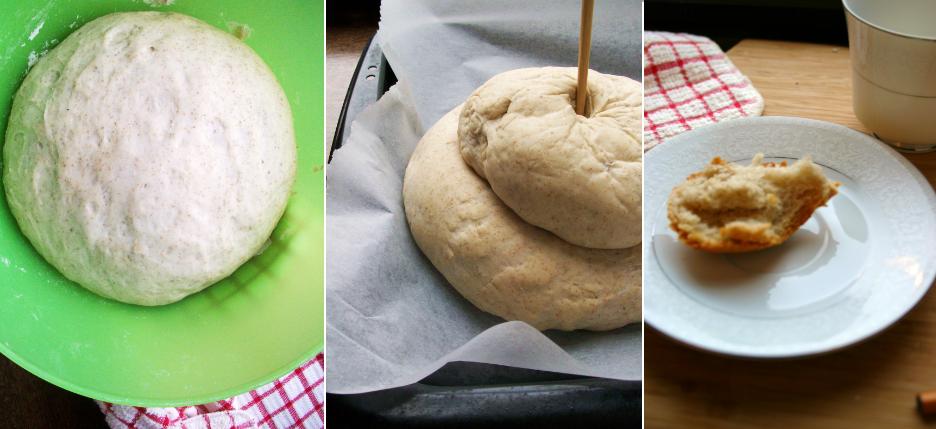
Where Woolf hesitated to praise her own writing, she wasn’t nearly so shy about her talent for baking. “Cooked lunch today and made a loaf of really expert bread,” she wrote. Bread was her specialty, particularly a traditionally British double-decker creation: the snowmanesque cottage loaf. Her dedication to the kitchen was unusual for a woman of the upper-middle class. She did, however, draw the line at doing the dishes (“How servants preserve either sanity or sobriety if that is 9/10ths of their lives … God knows”).

In Recollections of Virginia Woolf, Louie Mayer, the Woolfs’ cook, marvels at Virginia’s calm expertise. “She showed me how to make the dough with the right quantities of yeast and flour, and then how to knead it. She returned three or four times during the morning to knead it again. Finally, she made the dough into the shape of a cottage loaf and baked it at just the right temperature.”

It’s Woolf’s birthday today; she would have been 131, although she didn’t make it even half that far, her mental illness wearing her away. But from Woolf’s letters, the time she spends cooking seems to be its own rest cure, clearing her head of everything else but the dough. “My bread bakes well,” she writes in her diary, and it resounds like a soothing mantra. If all else fails, I tell myself, my bread bakes well. My bread bakes well.

* * *

Virginia Woolf - Cottage Loaf Recipe

Continue reading “Virginia Woolf: Cottage Loaf”

George Orwell: Treacle Tart

George Orwell - Treacle Tart

Imagine this: It’s a Sunday night, the end of a long weekend full of gift shopping, cookie baking, and fun-but-exhausting holiday merrymaking. You can’t possibly cook now, you decide, and turn to your trusty takeout-menu drawer. What are you in the mood for, though? Thai? Italian? Indian? Ethiopian?

If there’s one thing I bet you didn’t say, it’s “British.” Despite the U.K.’s recent restaurant renaissance, its meals have been a culinary punchline for nearly a century, ever since World War I hobbled the country’s food culture. George Orwell summed up its characteristics rather bluntly: “simple, rather heavy, perhaps slightly barbarous.”

Orwell was obviously never one to hide his feelings about food; his travel writings slam chefs everywhere from France to Burma. You’d think he’d be a little kinder to his home cuisine, but he savages everything from fish and chips (“definitely nasty, and has been an enemy of home cookery”) to rice puddings (“the kind of thing that one would prefer to pass over in silence”) to pretty much any kind of vegetable (“usually smothered in a tasteless white sauce”).

But Orwell did reserve some praise for what was, in his mind, Britain’s crowning culinary glory: “sweet dishes and confectionery—cakes, puddings, jams, biscuits.” Best of all were the Christmas treats: plum pudding, and treacle tart, “a delicious dish … hardly to be found in other countries.”

So how could a food lover like Orwell explain the U.K.’s mediocre showing in the kitchen? As he tells it, it’s because the best English cooking isn’t at a charming bistro or fancy restaurant, but is made at home, where foreigners don’t have access. That may be bad news for tourists—but it’s a moment for home cooks to shine. When we’re baking scones or Yorkshire puddings, Orwell says, we can be chefs of our own making.

* * *

orwell images

Continue reading “George Orwell: Treacle Tart”

Beatrix Potter: Gingerbread Cookies

Among all children’s authors I loved growing up, Beatrix Potter always seemed the most wholesome by far. My favorite books were the eyebrow raisers: the delicious nastiness of Roald Dahl, the nightmarish worlds of Maurice Sendak. Even The Velveteen Rabbit gets borderline traumatizing. When the only person you truly love gets scarlet fever, and all your friends are burned, you can finally become “real” if you cry? That’s more drama than a episode of Dawson’s Creek.

I remembered Peter Rabbit and Jeremy Fisher as cuddly and innocent in comparison, but on a recent visit to the Morgan Library, I realized I had it all wrong: Potter had a not-so-secret dark side. Not a book goes by without some cute animal about to be skinned, drowned in a sack, or baked in a pie. Potter began her original draft of The Tale of Mr. Tod, “I am quite tired of making goody goody books about nice people.” Her editor nixed it; turns out, readers wanted those goody goody books.

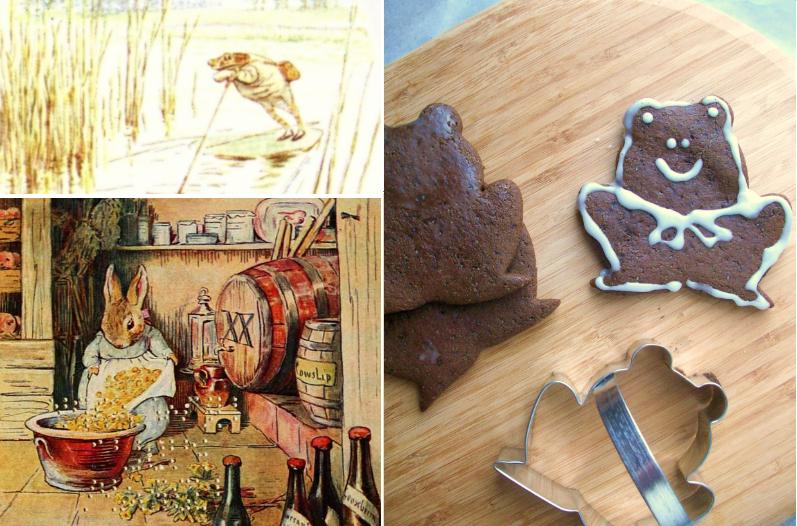
Still, a few less-than-goody bits made it into print. One of my favorite Potter characters is Cecily Parsley, an adorable rabbit who moonlights as a beer brewer. Potter’s illustrations show Cecily soaking some barley in front of comically large barrels marked “XX.” It’s impossible to imagine other favorite children’s characters doing the same: Anne of Green Gables opening up a distillery, or the Goodnight Moon mouse tippling on some homemade hooch.

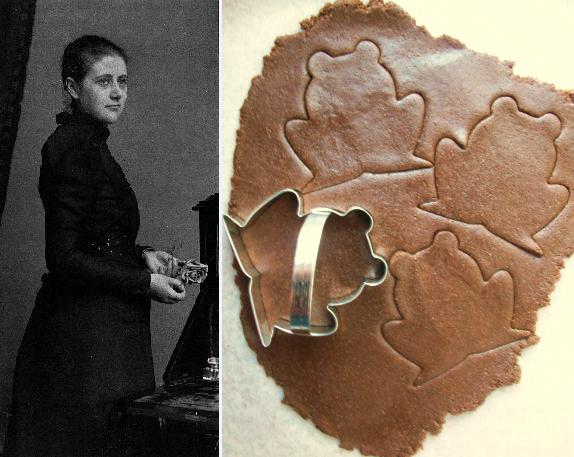
Did Potter take a cue from Cecily and start her own homebrews? Probably not. She did cook; at her beloved Hill Top Farm, in England’s Lakes District, she planted an herb and vegetable garden that Peter Rabbit would have loved to pillage. Much of her produce came from those gardens, but not all her recipes were virtuous. When Potter’s family recipe book went up for auction this fall, hiding in her gingerbread was a good dose of ale—a little bit of naughty in the midst of all that sugar, spice, and everything nice.

* * *

Continue reading “Beatrix Potter: Gingerbread Cookies”

J.D. Salinger: Roast Beef with Dijon Herb Rub

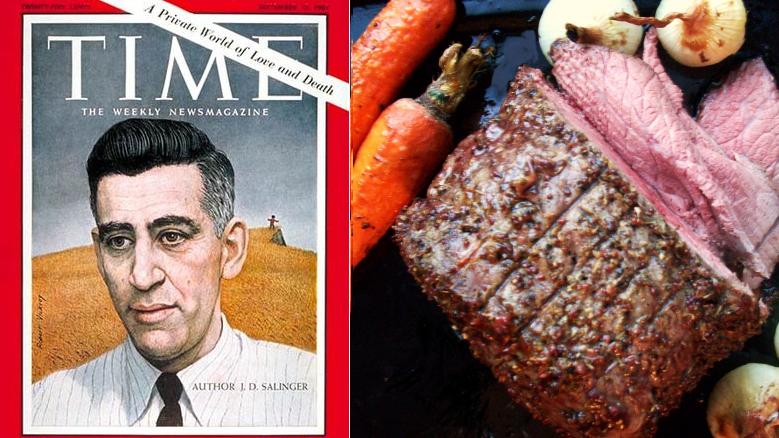
I have never been someone who is good at eating alone. I’m sure there are people who pull it off beautifully: pulling up a stool at a bar, trading witty banter with the wait staff, exuding total contentedness with their own internal world while sipping a martini. But not me. I can only imagine eating alone in the saddest possible way: hunched over in a booth, its plastic coating sticking to the back of my legs, while I shovel a plate of pasta into my mouth and my tears mingle with the condensation on a plastic cup of Mr. Pibb.

It’s not that I don’t like being alone. Some things—museums, books—benefit from a little solitude. But food, to me, is meant to be shared. It’s why I love Thanksgiving, and why J.D. Salinger has always fascinated me. There are days when being a recluse sounds pretty appealing (I’m looking at you, mandatory “networking” events). But how often can you make yourself a lonely salad for dinner?

It wasn’t like that, really; not like Salinger shut himself up in the attic, getting food delivered via dumbwaiter. His family ate meals together, and you could catch him stopping by Howard Johnson’s or Burger King (his fast food of choice). Every Saturday, he even joined the queue for the legendary suppers served by the First Congregational Church in Hartland, Vermont. But you could always pick him out in a crowd. That guy sitting by the pies, writing in a spiral notebook, alone in a sea of people? That was Salinger.

Where he did like some company was at the movies; his daughter, Margaret, called watching Hitchcock films together “our shared world.” But once things got sappy, he was done. “Christ, all you and your mother want to see are sentimental pictures about Thanksgiving and puppy dogs,” he told Margaret. Maybe that’s why he preferred dining alone – because eating together brings out all these emotions in us. I’m sure I’ll be having some serious feelings this Thanksgiving. I wish the same for you – you know, if you’re into that kind of thing.

* * *

Continue reading “J.D. Salinger: Roast Beef with Dijon Herb Rub”

C.S. Lewis: Cinnamon Bourbon Rice Pudding

With Sartre and his halva addiction, Agatha Christie and her devotion to cream, and Wallace Stevens’ cookie obsession, writers seem to thrive on a sugar high. Halloween must be a very productive time of year, creatively speaking: too gloomy to go outdoors, and lots of candy at hand to fuel the creative spark. It makes you wonder how many Great American Novels could only have been written with a steady supply of cake, cookies, and caffeine.

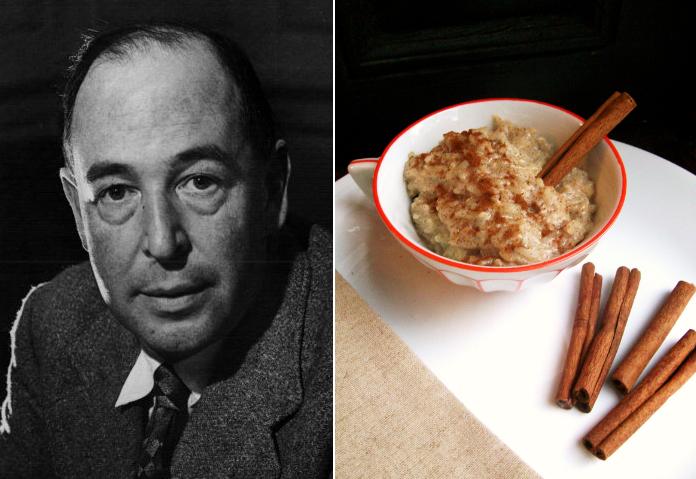
But just as I was beginning to think that sweets were the secret to success, C.S. Lewis broke the mold. He is not only ambivalent toward candy – he actually refuses to eat it. To someone whose favorite part of Halloween is stocking up on half-price Reese’s the morning after (don’t judge), this is the most harrowing discovery of the season.

Lewis comes up with various excuses for avoiding sugary treats: “I’m getting terribly fat and have had to diet” or “I can’t afford to buy a new wardrobe every few months!” He once wrote to a friend, who apologized for sending him stationery rather than sweets, “I must confess that I eat notepaper and envelopes, so your very kind gift may be described as being that of the edible variety.” Which is all to say what Lewis would ultimately admit: “I have not a sweet tooth.”

But his distaste for the insubstantial went further than food. Lewis also disdained literature that went down a little too easily. He cautioned a friend against detective novels, saying, “A little sense of labour is necessary to all perfect pleasures I think: just as (to my palate at least) there is no really delicious taste without a touch of astringency … The apple must not be too sweet.” Who would have thought the immortal creator of Narnia could wind up being the trick-or-treater your mother would love: He’ll leave the M&Ms, and ask for a Granny Smith instead.

* * *

Continue reading “C.S. Lewis: Cinnamon Bourbon Rice Pudding”

Allen Ginsberg: Aloo Gobi

When I was a kid, I hated lamb. Well, let me clarify: My mother hated lamb, so I hated lamb. I had never actually tasted it, since it was barred from our home, but that was entirely irrelevant to my 10-year-old self. My mom seemed to be right about everything else, so why would she be wrong about lamb?

It wasn’t until I moved away—with an apartment of my own and a boyfriend who tore into lamb like a rabid chupacabra—that I actually took a bite. It was at an Indian restaurant, another territory where my family had always been cautious. We’d consider the menu at length: lots of thoughtful nodding with a smattering of “hmm”s. Then we’d order the same chicken tikka masala and garlic naan we always did.

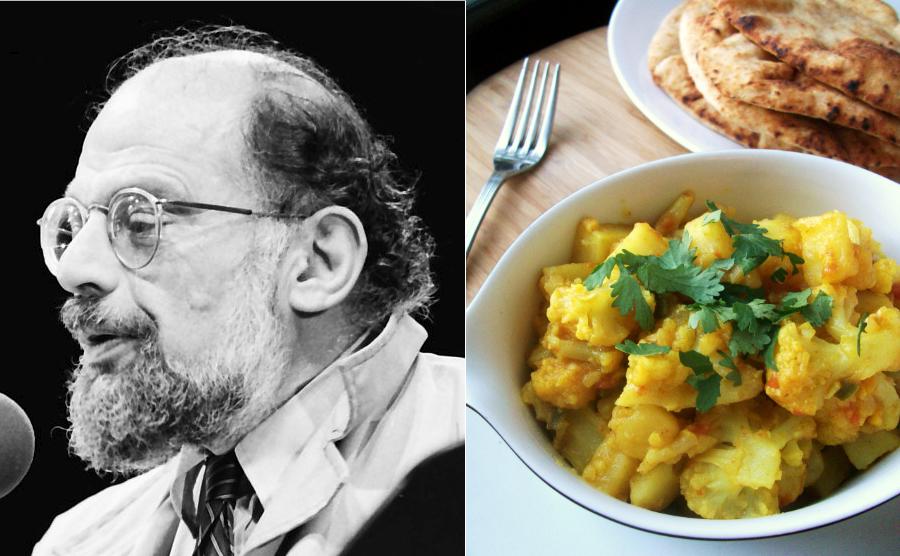
Allen Ginsberg had our number. Traveling around India in the 1960s, practicing Buddhism and Krishnaism, Ginsberg was eager to bring his new lifestyle to the States. He had just one concern, he told Hare Krishna founder A.C. Bhaktivedanta Swami Prabhupada. Could Americans handle the food?

Allen Ginsberg: So my question is this: … Is this something that a large mass of people can enter into?
Srila Prabhupada: In time, yes. Why not? …
Allen Ginsberg: Yes, but what it requires is an adaptation to Indian dress and
Srila Prabhupada: That is not very important.
Allen Ginsberg: And an adaptation to Indian food. …
Srila Prabhupada: Then that is Indian food? Do you mean to say it is Indian food?
Allen Ginsberg: Well, the curried vegetable dishes.

Although Ginsberg seems skeptical that potential converts could handle the Hare Krishna diet, he was a culinary adventurer himself. In his letters, Ginsberg lists dozens of local delicacies he sampled over the course of his wanderings, like a beat-poet Anthony Bourdain. In Hong Kong, he recommends the 100-year eggs; in Korea, try the snail and cuttlefish dish; in Denver, check out the all-organic Mercury Cafe (where you could catch him singing the occasional set with his rock band).

But even Ginsberg had his own culinary prejudices to overcome. In a letter to the poet Gary Snyder, he expressed surprise at how well he ate in India. “Food quite good … Bombay has great food all over. I’ve even drunk water practically all over and not been bugged. And everybody tells me it was instant death.”

* * *

Continue reading “Allen Ginsberg: Aloo Gobi”