Charles Dickens: Apples à la Princesse

Thinking of Dickensian food conjures up two extremes – the stuffed goose and figgy pudding feast of A Christmas Carol and the sad gruel rations of Oliver Twist. During Dickens’ 200th birthday celebrations this month, there was a lot of talk of the former. Nobody seemed as excited about the gruel, but there are plenty of resources to help you make an authentic Victorian version that actually sounds kind of great (Favorite BBC quote: “We were hoping he’d make it far more disgusting.”)

Given the fame that Dickens achieved in his lifetime, he didn’t have to beg for second helpings. But one of his favorite dishes, baked apples, was quite simple, not to mention practical: He swore by their ability to prevent seasickness.

Dickens became a baked apple convert while sailing to Boston in 1867. They were served at every meal during the Atlantic crossing, and he always helped himself. “I am confident that they did wonders, not only at the time, but in stopping the imaginary pitching and rolling after the voyage is over,” he wrote to his sister-in-law, Georgina Hogarth.

The magical apple diet clearly made an impression, and in 1881 Charles Dickens Jr. dedicated an entire cookery column to them in Household Words, a revived version of his father’s weekly magazine. Apples were getting cheaper and were beginning to be imported from abroad, so baked apples could be made by anyone, anytime. Perhaps thinking of his father, Dickens Jr. stressed the health benefits of the fruit. “It is unnecessary to say how valuable apples are as an article of diet.” Turns out, Dickens had been on the edge of a trend: The earliest version of our famous “An apple a day” saying was first published in Wales in 1866, just a year before his trip to the States.

* * *

Continue reading “Charles Dickens: Apples à la Princesse”

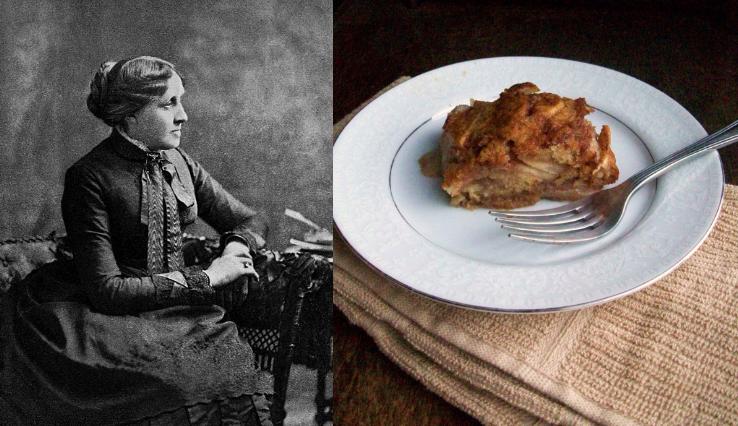
Louisa May Alcott: Apple Slump

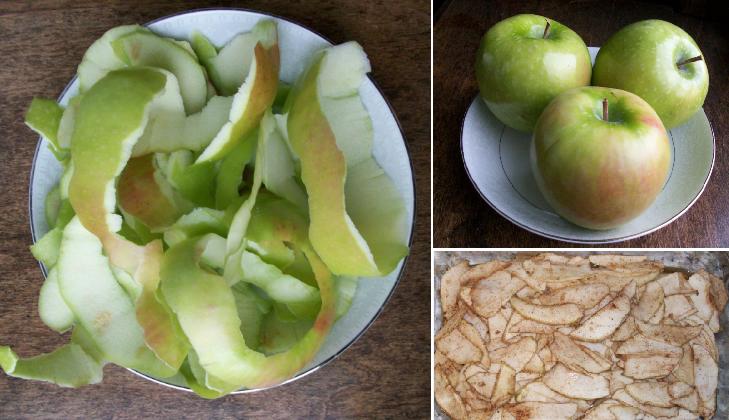
If something called a “slump” doesn’t make you salivate, how about eating a “grunt”? No? Then Louisa May Alcott will have your helping. They’re two different names for the same homey New England dessert: a dumpling crust over a baked (or steamed) fruit base, which was said to make grunting noises as it cooked down.

Another name? Pandowdy. Still hungry?

But Alcott loved the dish so much that she nicknamed her house after it. Orchard House, where she lived for nearly 20 years, famously provided the setting for Little Women as well as the backdrop to many Alcott family adventures. With a 12-acre apple orchard, as well as neighbors including Nathaniel Hawthorne and Ralph Waldo Emerson, it was an idyllic place both to grow up and to bake.

Louisa’s parents, well-known transcendentalists, had tried and failed to start an agrarian commune called Fruitland (sadly not a fruit-based theme park) before buying Orchard House in 1857. So when Alcott and Hawthorne often referred to the new house as Apple Slump, it was both a fond reference to the favorite dessert as well as a wink at the prior collapse of Fruitland, a slump in its own right.

* * *

Continue reading “Louisa May Alcott: Apple Slump”

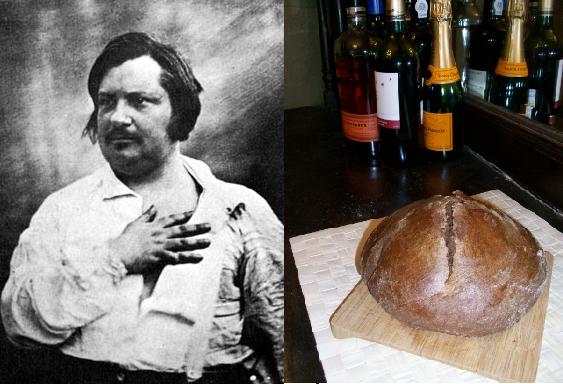
Honoré de Balzac: Ukrainian Black Bread

You might have seen the title of this post and had an immediate disconnect. Balzac and Ukrainian black bread? Wasn’t he more of a baguette kind of a guy? But that’s one of the things I love about Balzac. He was a baguette kind of guy. And a peasant bread kind of guy. And a traditional Easter paska bread kind of guy. He was just a man who loved food. He was a fan of the whole genre.

He is also one of the best writers of early “food erotica,” lingering over an account of a meal sometimes for several pages. Take one of his shortest descriptions in The Seamy Side of History: a breakfast of “monastic frugality” that “consisted of a small turbot with white sauce, potatoes, a salad, and four dishes of fruit: peaches, grapes, strawberries, and green almonds; then, by way of hors d’oeuvres, there was honey served in the comb as in Switzerland, besides butter, radishes, cucumber, and sardines.” If that’s what they’re serving at monasteries, sign me up.

Balzac’s encounter with Ukrainian bread happened late in life, but at a transformative moment. In 1832, he began a correspondence with one of his readers, a married woman living near Kiev who enigmatically signed herself “The Foreigner.” It was the beginning of a fifteen-year long-distance relationship – and soon Balzac found himself falling in love with his pen pal, Ewelina Hańska. So when her husband died in 1841, Balzac made his move, traveled to meet her, and eventually married her at her estate, in what’s now Ukraine.

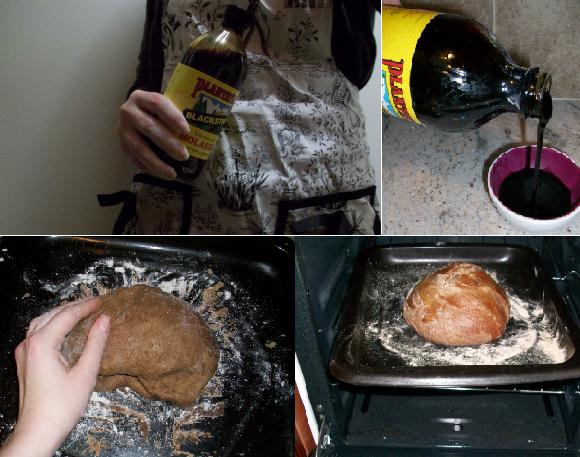
Ewelina wasn’t the only thing that impressed him about the country – the bread did. He famously counted 77 different kinds of bread-making techniques used there, a fact that local tourism brochures don’t hesitate to play up (Visit scenic Ukraine! Land of the fabled 77 breads!).  And one of the most popular (and most delicious) is the Russian black bread, which gets its color from dark rye flour.

* * *

Continue reading “Honoré de Balzac: Ukrainian Black Bread”