Henry James: Vanilla Ice Cream with Brandied Peaches

vanilla ice cream brandied peaches recipe

Around the middle of August, when vacations are past and sunset creeps up noticeably earlier every evening, end-of-summer anxiety sets in. How could I have let this happen? I didn’t have nearly enough picnics! Or take enough strolls through the park! Or eat all the corn, cherries, and peaches that summer demands! Suddenly, every weekend is wasted unless it includes at least one rooftop meal and one — okay, two — stone-fruit desserts.

If that seems overly dramatic, you should hear Henry James tell it. Born and raised in Manhattan, he would run errands with his mother to Washington Market, where farmers unloaded their produce onto the Hudson piers. He was struck by the bounty of summer there, “bushels of peaches in particular, peaches big and peaches small, peaches white and peaches yellow,” he wrote in A Small Boy and Others. “Heaps of them, the high-piled receptacles at every turn, touched the street as with a sort of southern plenty.”

When James wrote about losing the fruit of summer, though, he wasn’t just bummed there’d be no more pie for a while. In typical Jamesian fashion, the end of the market was a reminder of the passing of youth and (if we want to get really profound) of a bygone era. “What did the stacked boxes and baskets of our youth represent but the boundless fruitage of that more bucolic age of the American world …? Where is that fruitage now? Where are the peaches d’antan?”

Elegies like that make me feel like I should get to pondering Questions of Significance, not of granita recipes. But then I remember that James’ love of summer produce wasn’t entirely symbolic. In 1874, preparing to return home from a trip to Germany, he implored his mother, “Be sure about Sept. 4 to have on hand a goodly store of tomatoes, ice-cream, corn, melons, cranberries and other indigenous victuals.” Whenever I visit my family in California, I make practically the same request. And every Sunday, my mother and I make a run to the farmers’ market. There, even in winter, when my New York market stalls are all brown root vegetables, the stands still overflow with the colors of an everlasting summer.

* * *
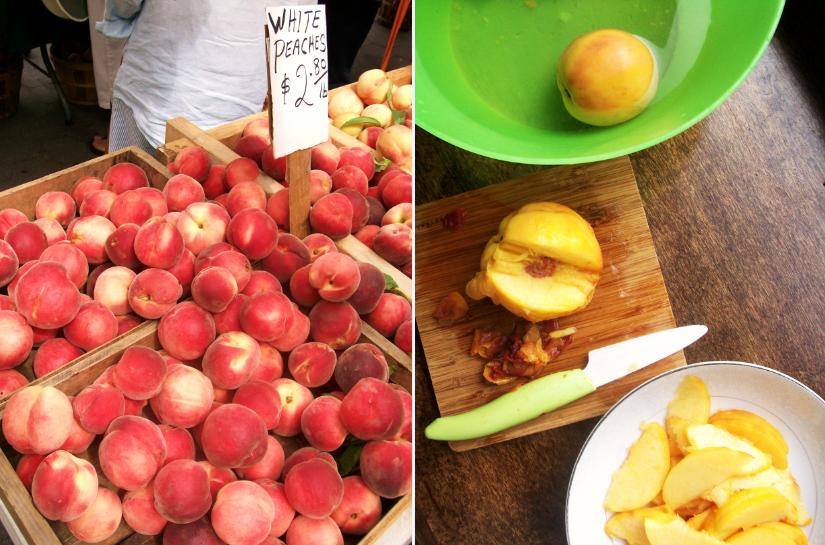
peaches farmer's market

Continue reading “Henry James: Vanilla Ice Cream with Brandied Peaches”

The Cocktail Hour: Robert Penn Warren

grapefruit gin punch cocktail recipe

“I had a birthday – only a few days ago – and am now thirty-eight,” wrote Robert Penn Warren in 1943. I’ve had birthdays on the brain, having also celebrated one recently. It wasn’t a big, round number, but it was a perfect square, the mathematics of which somehow seem especially daunting. It’s that age when we’re expected to put away childish things and start careers, find ourselves, tie the knot, settle down, paint the nursery, take out a mortgage. Instead of doing those things, I started this blog.

Clearly, a cocktail was in order. Luckily, Warren had just the thing.

Although it doesn’t have the universal significance of a 30th or a 40th, Warren’s 38th birthday was actually a very noteworthy one: It meant he could no longer be drafted into World War II. To celebrate, Warren threw “a gentlemen’s party with a particularly insidious punch” and invited his colleagues from the University of Minnesota, where he directed the creative writing program. If you think tenured professors don’t know how to party, think again: The revelry lasted almost seven hours, and they went through four gallons of punch.

If Warren’s parties were anything like his letters, they would have been a wickedly good time. Biding his time before At Heaven’s Gate to be published, he was full of writerly gossip, from who was a hack to who just got thrown in prison. He hates on the Chicago Tribune (“the world’s stinkingest paper but pays well”) and gives begrudging praise to The Nation (“doesn’t pay well but … is respectable”). August Strindberg and William Somerset Maugham? “Pure horse droppings.”

I can only imagine what bons mots Warren, on a little too much punch, might have dropped at his birthday shindig. He claimed that “high aesthetical conversation raged until a late hour,” but later dropped the act and just admitted the discussion was “more noise than wit, but the noise sounded like wit at the time.” It’s easy to take yourself too seriously as major birthdays loom, which might be why so many grown-ups have such dull parties. But Warren shows it doesn’t have to be that way. Just mix a group of good friends, a lot of noisy laughter, plus a glass of something delicious to wash it all down.

* * *

Robert Penn Warren grapefruit gin punch

Continue reading “The Cocktail Hour: Robert Penn Warren”

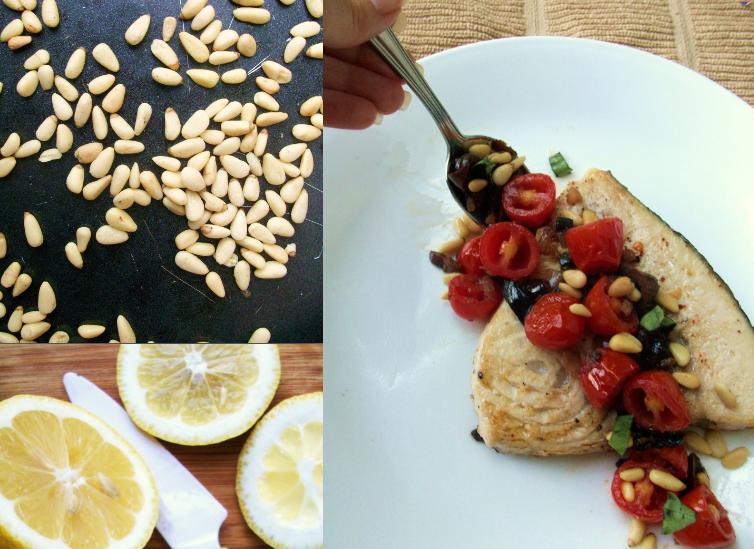
Raymond Chandler: Swordfish Siciliana

What to cook for Raymond Chandler on his birthday? If he’s known for anything vaguely digestible today, it’s Terry Lennox’s gin gimlet recipe from The Big Sleep: “half gin and half Rose’s lime juice and nothing else.” Sometimes that can be the basis of a whole birthday dinner menu, but it’s usually unintentional (and ill-advised, if my “popcorn and whiskey” birthday was any indication).

But it turns out Chandler had more than a few recipes up his sleeve – maybe even a cookbook’s worth. While working on The Long Goodbye in La Jolla, California, he wrote to editor Dale Warren with another surprising proposal. “Somebody really ought to write a cookbook and put in all the things that the regular cookbooks leave out, the things which, if you’re a beginner, the cookbooks don’t tell you,” he said. “Also, any decent cookbook should have a few special recipes, a touch of the unique. And this I could easily supply.”

Seen through his letters, Chandler becomes the Mark Bittman of La Jolla. He’s minimalist in his approach to food (his recipe for pork chops: “Cook them in their own fat, they bring everything with them that is necessary except salt and pepper.”). But he’s also deeply critical of Americans’ slide into non-cooking, 50 years ahead of the curve. He scorns his neighbor’s dependence on “a deep freeze unit in his garage where he keeps enough food for six months … Most of the other food he eats comes ready-prepared and half-chewed.” If you think that’s harsh, Chandler goes on: “I sometimes wonder what we are here for. Certainly not to use our minds.” It’s a relief he wasn’t around to see the rise of the Hot Pocket.

Chandler would have turned 124 today; I’ll celebrate my own birthday later this week. No popcorn and whiskey for me this time around. We’re older now, and wiser. We use our minds. We plan our menus. And there won’t be anything frozen or ready-made, although there may well be a gimlet or two.

* * *

Continue reading “Raymond Chandler: Swordfish Siciliana”

Nora Ephron: Frozen Key Lime Pie

My first Nora Ephron experience was watching When Harry Met Sally backwards. It was the week between Christmas and New Year’s Day, that week when cable channels run marathons of the film, back to back, all day long. On holiday from school, with nothing better to do, I randomly flipped on the TV to the last scene, when Billy Crystal and Meg Ryan finally end up together and everyone sings “Auld Lang Syne.” I stumbled upon another scene later that day, on a different showing: the epic fight over the wagon wheel coffee table. Finally, I caught it at the beginning and watched the whole thing. Seeing it that way was pleasingly disorienting — Nora Ephron meets Harold Pinter.

Ephron might not fit the mold of other writers on this blog—Crazy Salad doesn’t occupy the same place as Crime and Punishment, nor should it—but she was in a class of her own when it came to pure food joy.” I have a friend whose mantra is: You must choose,” she said. “And I believe the exact opposite: I think you should always have at least four desserts that are kind of fighting with each other.”  She wasn’t shy to share her culinary opinions, either, particularly in the Great Egg White Controversy of 2007. Her recipe for egg salad began: “Boil 18 eggs, peel them, send six of the egg whites to friends in California who persist in thinking that egg whites matter in any way.”

It’s no surprise, then, that food made its presence felt in Ephron’s fiction writing too. Her 1983 novel Heartburn is maybe the best example, seamlessly integrating recipes into the plot. Now the novel/memoir-with-recipes genre seems ubiquitous—everyone from Kim Severson to Ruth Reichl has one—but Ephron did it first, and best. She knew that cooking and storytelling share a common thread: The words draw people in, and the food draws people together. Some books are best enjoyed in solitude, but not Nora’s. They beg to be shared, the best passages read aloud to anyone around to hear them.

I got the news that Ephron had died right before boarding a plane for California, where I grew up. Back in my family’s kitchen, I started squeezing the juice for her Frozen Key Lime Pie. Although I had read many of her recipes over the years, this is the first one I was attempting. Finally, I thought, I’d have what she was having.

* * *

Continue reading “Nora Ephron: Frozen Key Lime Pie”

Wallace Stevens: Coconut Caramel Graham Cookies

If cookies were a literary genre, I suspect they’d be the romance novel. Neither one gets much respect in highbrow circles, but both have a dedicated, verging-on-rabid following. They’re the perfect accompaniment to a rainy Sunday afternoon – and it’s dangerously easy to consume several in one sitting.

But unlike romances, with their embossed and be-Fabio’ed covers, cookies aren’t winning any beauty contests. They’re usually not much to look at, which is one reason why they’re more often found in our home kitchens than on restaurant menus. They’re homely in every sense.

If you had met him on the street, you might have thought Wallace Stevens was similarly unremarkable. Every day for over 40 years, he got up, got dressed, and commuted to his achingly normal day job at a Connecticut insurance agency (Kafka also worked in insurance, which makes you wonder just what goes on over there). His humdrum evening routine consisted of eating a cookie while reading the paper. He didn’t publish his first poem until he was 35, and even after he won the Pulitzer, he still went to the office every day, and ate a cookie every night.

No other writer talks about cookies as much as Stevens does. Elsie, his wife, always seemed to have a batch baking; “I can almost smell them,” Stevens wrote in his letters. He brought them on picnics, and gave boxes of them away as Christmas gifts. Even Stevens’ daughter associated  with cookies; when he was away on business, she would put a cookie by his place at the table, waiting for him to come home.

Stories like that remind me why cookies, despite their homely status, are so beloved: They tie in to our most cherished memories, and remind us of those little moments that make life worth living. Stevens knew that power well. In 1948, after returning from a trip to New York with Elsie, he wrote, “We went into the kitchen, sat there drinking milk and eating cookies. … This is not much. Yet it is a little in spite of everything.”

* * *

Continue reading “Wallace Stevens: Coconut Caramel Graham Cookies”

Ernest Hemingway: Bacon-Wrapped Trout with Corn Cakes

Were you expecting a stiff cocktail? Fresh marlin? Braised wildebeest? Ernest Hemingway has become such a legendary character, it’s hard to think of a recipe that could match his macho reputation. It’s clear that the man loved food; A Moveable Feast is one of the most sincere odes to eating I’ve ever read. But did Hemingway cook?

Whether on a Cuban beach or the African savanna, Hem was a fan of the good life – and that included making good food. “It is all right to talk about roughing it in the woods. But the real woodsman is the man who can be really comfortable in the bush,” he wrote in an essay on camping for the Toronto Star.  As a kid, Hemingway spent many summers hiking through Michigan, and his ideal meal was a freshly caught fish. But most of his fellow outdoorsmen didn’t know their way around a griddle. “The rock that wrecks most camping trips is cooking,” he griped. “The average tyro’s idea of cooking is to fry everything and fry it good and plenty.”

As a solution, he proposed a simple but satisfying meal for any campfire cook. Trout was a favorite for Michigan fishermen, but it can dry out easily. So Hemingway suggested cooking it in layers of bacon, whose fat bastes the fish as it renders. “If there is anything better than that combination the writer has yet to taste it in a lifetime devoted largely and studiously to eating.”

Of course, sometimes the hardest part of cooking isn’t preparing the meal itself – it’s waiting for it to be done. Hemingway saw that coming, too. He recommended whipping up a batch of pancakes to serve before the main course, to satisfy any unhappy campers.

* * *

Continue reading “Ernest Hemingway: Bacon-Wrapped Trout with Corn Cakes”

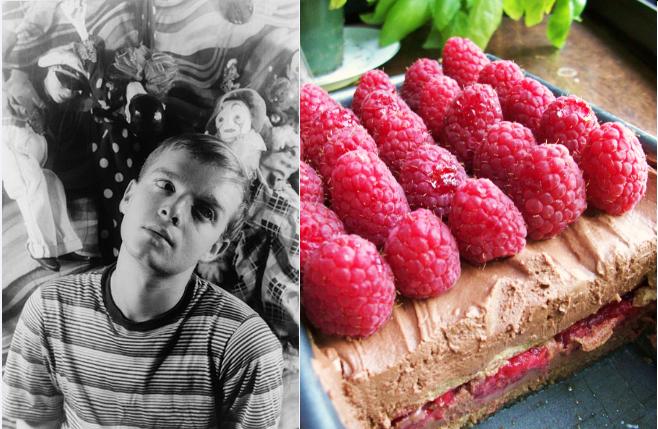
Truman Capote: Italian Summer Pudding

How long can you last before thinking about what to cook for dinner? It’s a rare occasion when I make it past lunch. Usually by my morning commute, I’m already gone – dreaming up recipes as I walk to the subway, devising shopping lists at lunch, dropping by the farmers’ market on the way home. So I know how Truman Capote felt when he wrote: “Food. I seldom think of anything else.” That kind of sums it all up, doesn’t it?

I’ve always loved eating food, but it wasn’t until I moved to New York—and had a kitchen to myself—that I began to love cooking it. If an aspiring writer needs a room of her own, a budding chef needs a kitchen: a private laboratory where she can experiment to her heart’s (and stomach’s) content. Capote’s chance came in 1950, when he settled down in Sicily with his partner Jack Dunphy. Capote always had a personal cook, but in Sicily he began to explore the kitchen himself – “an unmanly activity, I suppose, but very relaxing and the reward is delicious,” he wrote after a day making fruit preserves. Plus, he noted, storing jam was great way to “do something with these old gin and wine bottles,” a tip destined for the Pinterest boards of boozehounds everywhere.

What began as a way to pass the time became a food obsession, with a particular focus on sweets. After graduating from humble Toll House cookies to fancy chocolate confections, Capote ultimately took on the amateur cook’s triathlon: For Christmas in 1951, he presented Dunphy with a turkey, chestnut stuffing, and a multilayer orange almond cake.

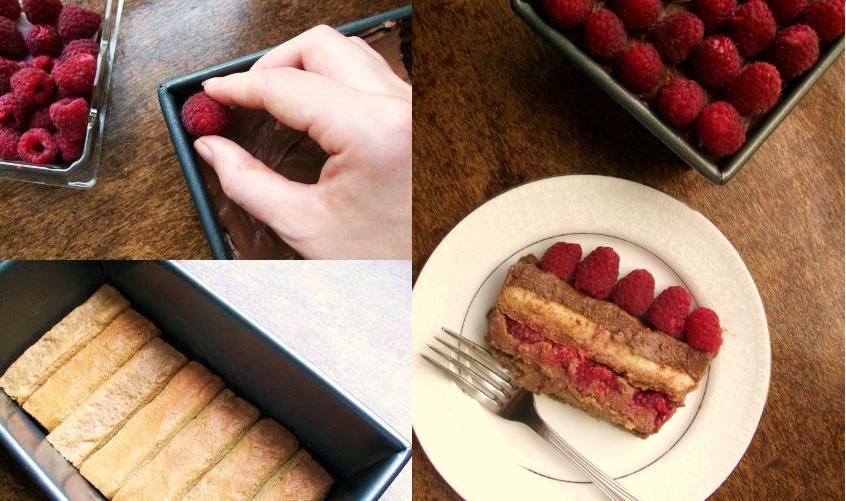
Despite his new culinary chops, though, Capote’s favorite treat was something he didn’t make. In 1962, on a trip to England, he and his friend Cecil Beaton lunched with the Queen Mother. But the royal company didn’t impress Capote – the dessert did. It was “the best cake I’ve ever tasted – a sort of chocolate cream stuffed with fresh raspberries,” he wrote. He wasn’t shy about expressing his enthusiasm, either; years later, Beaton remembered his friend cheering with joy when it was served. Because when a good dessert is involved, who can be bothered with a stiff upper lip?

* * *

Continue reading “Truman Capote: Italian Summer Pudding”

The Cocktail Hour: Oscar Wilde

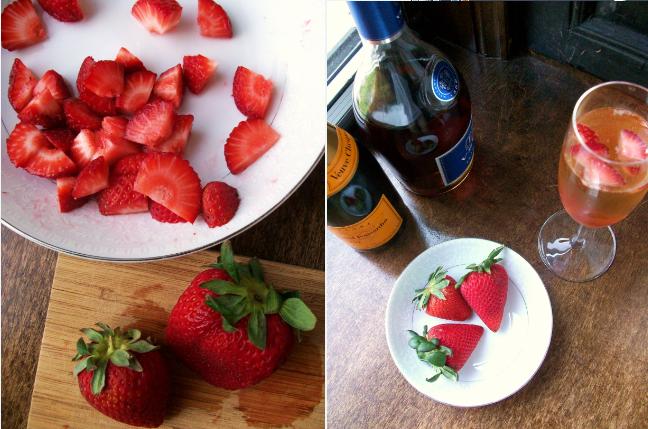
If I’m having a drink on a typical day, I’ll probably spring for a martini. On a tough one, give me a bourbon on the rocks. But when I’m feeling fancy, it’s always Champagne. Oscar Wilde must have been feeling fancy all the time.

It’s not a big surprise that one of the most famous dandies of literature had a serious Champagne fetish. But the lengths to which Wilde went to get his fix takes bubbly worship to a whole new level. At the best of times, there were elaborate champagne dinners … and pre-dinners and post-dinners; Wilde ordered his staff to serve champagne “at intervals” throughout the day. And at the worst of times – after being imprisoned for charges of indecency and sodomy – Wilde made the most of things by ordering cases of his favorite vintage, an 1874 Perrier-Jouët, straight to his cell. It even came up in the courtroom, according to the transcripts of his trial:

Mr. Oscar Wilde: Yes; iced champagne is a favourite drink of mine–strongly against my doctor’s orders.
Mr. Edward Carson, QC: Never mind your doctor’s orders, sir!
Mr. Oscar Wilde: I never do

Wilde’s taste for Champagne has become so legendary that it threatens to outstrip the truth. In a famous anecdote, Wilde was elegant until the very end, ordering champagne to his deathbed and sighing, “Alas, I am dying beyond my means.” But other accounts are a little less romantic – turns out, he may have just been thinking about his hospital bill.

* * *

Continue reading “The Cocktail Hour: Oscar Wilde”

Jack London: Bacon and Tomato Baked Risotto

On any cookbook shelf, stashed between the glossy covers and the celebrity chefs, there are always a few oddities. Maybe it’s the book you picked up from the giveaway pile at the library. Maybe it’s the gift your friend got you as a tragic joke. But my favorite finds in any collection are the community cookbooks: those spiral bound, DIY collections that bring together the favorite recipes of a group of friends.

Today it’s all about Kickstarter, but community cookbooks used to be a key fundraising tool: Throw in a few bucks for a cause, and you’d get enough recipes to last you the month (plus a tempting window into your neighbors’ kitchens). And one of the first groups to make use of the idea was the women’s suffrage movement. For the suffragettes, creating a cookbook was not only a savvy business move, it also helped counter women’s fears that voting was too radical, too masculine. Donating to a political cause can seem a little daunting. But buying a cookbook? That’s just good taste.

So where does a man’s man like Jack London fit in? Ever the outdoorsman, London was building a sustainable ranch in California when he met the writer Charlotte Perkins Gilman, a vocal supporter of the women’s suffrage movement. The two shared an interest in socialism, and soon London began to appear at Gilman’s suffrage rallies. When the Equal Franchise Federation of Western Pennsylvania was seeking recipes for The Suffrage Cook Book in 1915, London pitched in with a few of his “especial ‘tried’ favorites.”

London died a year after the cookbook’s publication, three years before women’s suffrage became a reality in 1920. Whether he was genuinely interested in the cause is up for debate – pushing for a ban on alcohol, he noted that when “the ladies get the ballot, they are going to vote for prohibition.” But to readers of the cookbook, London wasn’t a prohibition crusader, or even a big-name author. He was just a fellow activist – who happened to make a mean risotto.

* * *

Continue reading “Jack London: Bacon and Tomato Baked Risotto”

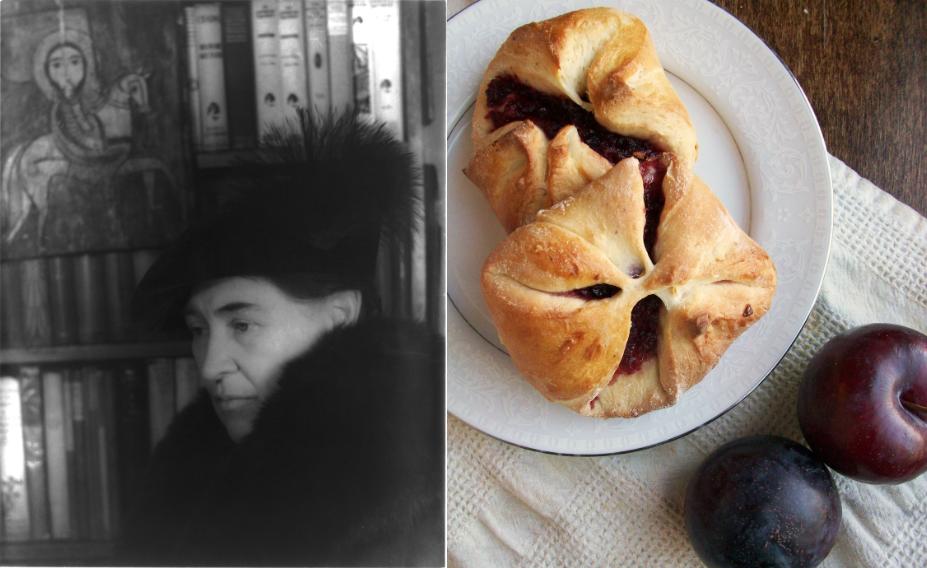
Willa Cather: Spiced Plum Kolache

Willa Cather - Spiced Plum Kolache

Two months ago, if you had asked me to describe Willa Cather, I would have pictured her writing in the middle of the Nebraska farmland, surrounded by as many sheaves of paper as sheaves of wheat. I didn’t realize that, when she was 23, Cather left the Great Plains for the big city; she moved to Pittsburgh and then to New York, where she lived for the rest of her life. She didn’t publish her first novel until 16 years after the move, when Fifth Avenue must have been just as familiar as the farm.

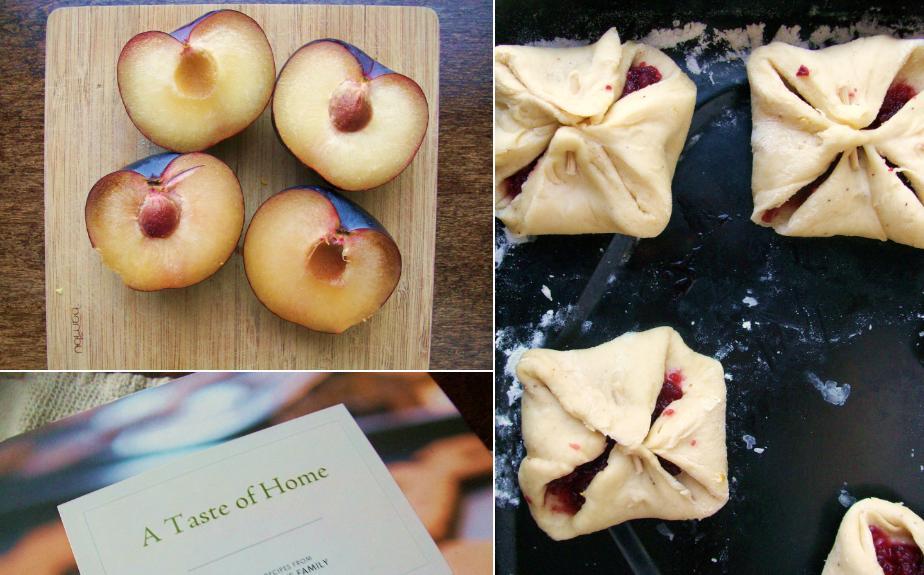
It’s no wonder, then, that food played such a major role in Cather’s writings: She needed it to bring her back to life on the frontier. With their incredible power to conjure up a time and place, food memories are some of the strongest associations around. More than anything else about a trip, I remember the meals: crabs in Baltimore, étouffée in New Orleans, pain au chocolat in Paris. When I left home in California for the unknowns of the East Coast, my mom sent me off with a bound compilation of our family’s favorite recipes. Seven years later, in my New York kitchen, I still flip it open when deciding what to make for dinner. It’s one of the best gifts I’ve ever gotten.

In Nebraska, Cather drew her cooking inspiration from Annie Pavelka, a Bohemian immigrant to the town of Red Cloud whose life (and food) would serve as the basis for My Ántonia. In her own New York kitchen, hundreds of miles from home, I imagine Cather consulting her recipes and rolling out her pastry dough like Annie did,  mentally recreating the pioneer communities of her childhood.

* * *

In Progress - Spiced Plum Kolache

Continue reading “Willa Cather: Spiced Plum Kolache”