John Cheever: Turkey Monte Cristo Sandwich

Whenever I need to make idle chatter, talking about meals is generally a safe, friendly topic – unless that meal is brunch. I’m going to go out on a limb here and say that lunch and dinner are pretty universally well liked. And while the merits of breakfast have certainly been debated (despite being repeatedly chastised for not eating it, I somehow am still alive), brunch just gets people unusually riled up.  For the anti-brunch lobbyist, the idea of forking over $20 for a couple of eggs leaves a bad taste in the mouth that no bottomless-mimosa deal can wash away.

But even the most dedicated day drinkers can’t hold a candle to John Cheever, whose brunches consisted of “a secret slug of whiskey at eleven … two martinis at noon.” In his journals, Cheever’s infamous struggle with alcoholism plays out in the endless litany of gin and tonics, martinis, and nightcaps that make up his daily menu, starting well before noon. Food is an afterthought, usually appearing sandwich form. “I work until one, when I eat my sandwiches and take a rest,” Cheever wrote of his daily routine, a schedule that looks very virtuous when the drinks are edited out.

It wasn’t until Cheever moved to Los Angeles in 1960, to adapt D.H. Lawrence’s The Lost Girl for the screen, that he began taking an interest in food – both as a way to stave off depression, and because it was all conveniently paid for by the studio. “I’d reach for the phone and order the most elaborate breakfast I could think of,” he told The Paris Review, “and then I’d try to make it to the shower before I hanged myself.”

For Cheever, a native New Englander, Hollywood didn’t have much going for it, except where sandwiches were concerned. He recounts in his letters the discovery of a new sandwich, like a rare and exotic bird: “For lunch Carl had something called a Monte Christo sandwich. This is made of three slices of French toast, turkery [sic] meat between the toast, the top sprinkled with powdered sugar and the whole cut into three sections, each looking like a Napoleon. This is eaten with a knife and fork. And this is my only life in Hollywood note for today.” For a sandwich aficionado at the time, this was a moment of revelation. It is also, I hesitate to add, an ideal morning meal after a long night of drink.

* * *

Continue reading “John Cheever: Turkey Monte Cristo Sandwich”
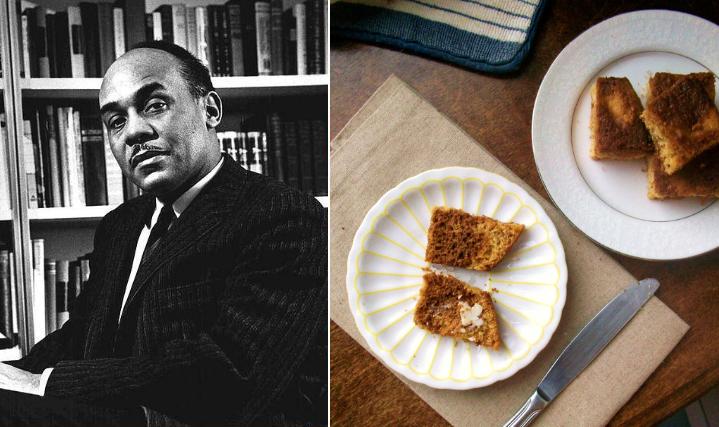
Ralph Ellison: Molasses Cornbread

There’s a scene in Ralph Ellison’s The Invisible Man that has become one of the most famous food passages in history. The unnamed narrator, passing a sweet-potato vendor on the road, is transported back to his childhood in the South, happily recalling meals of fried chicken and chitterlings – foods that soon became too racially charged for him to enjoy. But in this moment, the narrator is changed: He gets three orders of potato, newly determined to eat what he likes without shame. “I yam what I am,” he shouts, transformed (and if your mind went straight to Popeye, just remember what a dramatic effect food had on him).

Food unexpectedly changed the course of Ellison’s life: When he started studying music at the Tuskegee Institute, he also began working long hours in the dining hall, in order to pay off his tuition. You could find him on the early shift – 5 a.m. to 1 p.m. – baking cornbread and pouring bowls of molasses for the breakfast service. And after graduation, it was cooking – not music – that landed Ellison a job. Failing to score a coveted spot as a trumpeter in a military band, he instead found work as a cook on a Liberty ship, turning out versions of the Southern staples he learned at Tuskegee: cornbread, biscuits and fried pies.

It wasn’t until Ellison began traveling abroad, away from the Southern dishes that had defined his early years, that he realized how they had worked their way into his being. Living in Rome in 1956, Ellison wrote to his friend and fellow writer Albert Murray, “I got no way to get any corn bread … no sweet potatoes or yellow yams, a biscuit is unheard of – they think it means a cookie in this town – and their greens don’t taste like greens.”

Today fried chicken and stewed greens have gained gourmet cred – collard green risotto is totally a thing – but there will always be foods that feature guilt as a main ingredient. The phrase “you are what you eat” has become a grim warning, baking shame into things that ought to be enjoyed in moderation. We focus so much on the physical effects of our diet, it’s easy to forget that food can change us in other ways – ones that don’t involve calories or celery sticks but instead affect our minds and hearts: sweet potatoes for comfort, ice cream for renewal, chocolate for joy.

* * *

Continue reading “Ralph Ellison: Molasses Cornbread”