Gabriel García Márquez: Lobster Tail with Spaghetti and Bread Crumbs

In the pantheon of great literary friendships – Kerouac and Ginsberg, Emerson and Thoreau – Gabriel García Márquez and Fidel Castro isn’t a wildly popular pair. What does the master of magical realism have to chat about with the Cuban president? And who said Castro is literary, anyway?

Well … Márquez did. “It may not be widely known that Fidel is a very cultured man,” he told Playboy. “When we’re together, we talk a great deal about literature.” And when they met for the first time in 1977, Castro and Márquez discovered another shared bond: They were both seafood fiends. What began as a diplomatic exchange about Angola turned into a lengthy conversation about lobster recipes. The same thing happens when my family starts talking politics at the table; we end up retreating to a common ground and asking what’s for dessert.

It was the beginning of a culinary kinship. Over the next few years, they rhapsodized over shrimp. Their dinner menus were odes to the sea. When a Cuban chef who frequently cooked for the high-powered pair published a book, he included the recipes he associated with them: turtle soup for Castro, and lobster for Gabo.

Although Castro’s fondness for spaghetti threatened to eclipse his shellfish infatuation (“Fidel is still doing spaghetti,” Márquez sighed in an article in 1985), he knew what he wanted where seafood was concerned. “It’s best not to boil shrimp and lobsters, because the boiling water weakens the substance and flavor and makes the meat a little bit tough. I like to broil them in the oven or grill them. … For condiments, just butter garlic and lemon. Good food is simple food.”

* * *

Continue reading “Gabriel García Márquez: Lobster Tail with Spaghetti and Bread Crumbs”
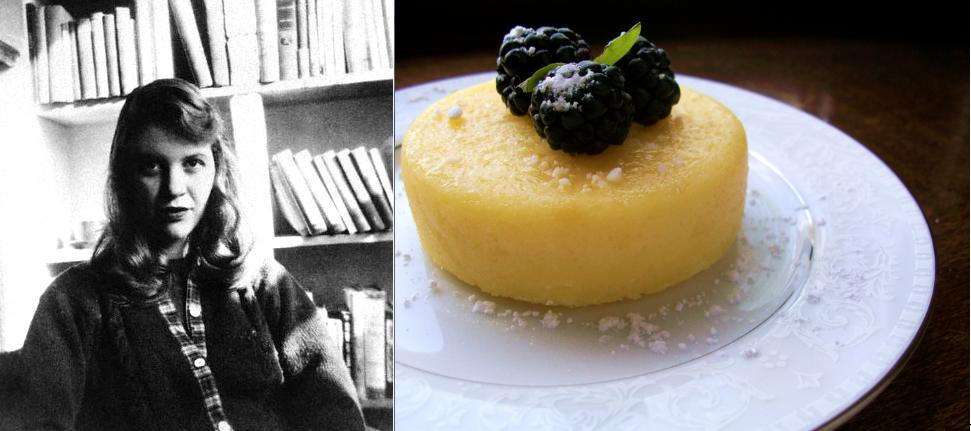
Sylvia Plath: Lemon Pudding Cakes

Is it taboo to write about baking and Sylvia Plath? When I told a friend what I was cooking this week, his face froze in a half-smile. “Oh, um, ha! But really, what are you making?” Another awkward reaction: “Well … be careful?”

I still feel like I’m tiptoeing around the elephant in the room every time I mention an oven. But, as for many a 1950s-era wife and mother, cooking and baking were large parts of Plath’s daily life, and not unwelcome ones. “How I love to cook!” she wrote in her journals – and apparently she was no slouch either. Ted Hughes praised his wife’s cooking in his letters: “Sylvia by the way is becoming the most superlative cook I’ve encountered.” To him, she was “a princess of cooks.”

We tend to think of cooking, and particularly baking, as a soothing, cathartic experience. But, as anyone who has put together a dinner party (much less run an actual bakery) can attest, it can lead to some very un-soothing thoughts. Did I beat the eggs enough? Shouldn’t it be rising more? What if I didn’t grease the ramekins enough and half of the cake sticks and then it breaks in half and the whole thing is ruined and then what will I do? THEN WHAT?

Plath seemed to have a similar dual reaction to her time in the kitchen; it was both a blessed release and a warning sign, a suffocating dead end. In 1957, after a day spent baking a pie, Plath worriedly wrote in her journal, “You will escape into domesticity & stifle yourself by falling headfirst into a bowl of cookie batter.” It’s an uncomfortable moment, a hint of things to come.

* * *

Sylvia Plath Lemon Pudding Cake

Continue reading “Sylvia Plath: Lemon Pudding Cakes”

John Steinbeck: Pork Posole

John Steinbeck was a locavore before it was cool. No matter where he was writing from, his letters always mention the local produce. In California, he bought a cow so he could make his own butter and cheese. In England, he foraged for dandelion greens (“cook them slowly and for a long time with pieces of bacon”). In Sag Harbor, he reveled in the local seafood (“I figure I can always catch my dinner”).

But sometimes you come home after a long day, and you don’t want to knead your own bread, dry your own pasta, butcher your own goat. You just want to buy a whole baguette, put some brie on it, eat it all while watching The Wire on Netflix and call that dinner. “I like good food and good clothes, but faced with getting them I can’t round myself into a procuring unit,” Steinbeck wrote in a particularly lethargic mood. I imagine he said it on the sofa in sweatpants.

Often it’s the presence of other people that keeps me from nights of cheese sandwiches in front of the TV; cooking for company is just more fun! But when Steinbeck was alone on the road, he would forget the butter-churning and revert to the life of a single guy. Hence his recipe for posole, borrowed from his friend (and famed screenwriter) Jack Wagner: “a can of chili and a can of hominy.” Hello, bachelorville.

* * *

Continue reading “John Steinbeck: Pork Posole”