Jean-Paul Sartre: Halva with Almonds

Food often tops our list of guilty pleasures, but it’s hard to think of famous writers indulging in the gratuitous and occasionally sordid ways we do. When I was in college, part of my late-night routine was to buy a huge bag of Tostitos with lime, eat the whole thing while writing a paper and—in one final profligacy—scrape the fake citrus-flavored salt out of the corners of the bag. Trying to imagine Camus doing that just feels wrong.

But there’s probably a kernel of truth to it, if Jean-Paul Sartre’s letters are anything to go by. Sartre had his cravings too, and while he was fighting with the French army during World War II, his letters to Simone de Beauvoir repeatedly mention the same thing. He demands halva.

In between discussions of Weltanschauung and his work on Being and Nothingness, Sartre can’t stop talking about halva. “Don’t forget,” he reminds de Beauvoir in 1939, when asking her to send two boxes. Then, in a following letter: disaster. “I was in an excellent mood today, and then I got your books (the Romains) but no halva. Is there another package?”

But when Sartre does receive halva, multiple times over the next few years, his joy is palpable. “The halva arrived in good order … Thank you very much, my little sweet. We ate the whole box at lunch.” And later: “I gave the halva to Pieter, who carried on about it so, that I bawled him out. At this very moment he’s eating a big chunk with great satisfaction.”

The letters between Sartre and de Beauvoir are also incredibly beautiful. But Sartre’s sweet tooth makes him just a bit more relatable. Existentialists: They’re just like us.

* * *

Continue reading “Jean-Paul Sartre: Halva with Almonds”

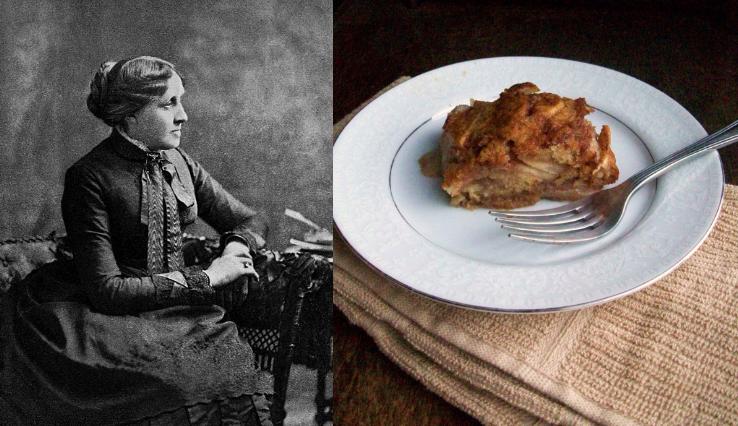
Louisa May Alcott: Apple Slump

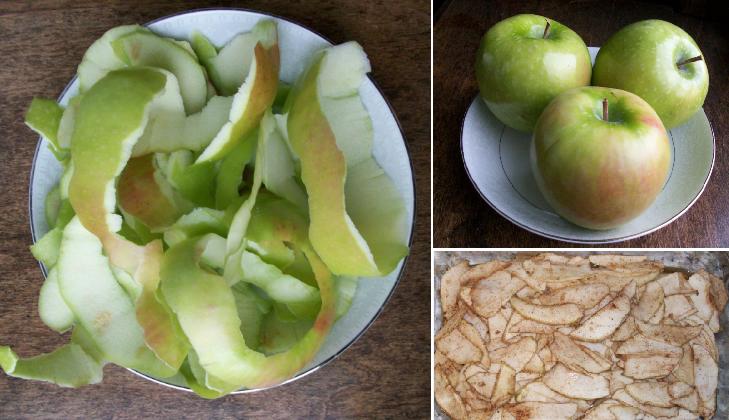
If something called a “slump” doesn’t make you salivate, how about eating a “grunt”? No? Then Louisa May Alcott will have your helping. They’re two different names for the same homey New England dessert: a dumpling crust over a baked (or steamed) fruit base, which was said to make grunting noises as it cooked down.

Another name? Pandowdy. Still hungry?

But Alcott loved the dish so much that she nicknamed her house after it. Orchard House, where she lived for nearly 20 years, famously provided the setting for Little Women as well as the backdrop to many Alcott family adventures. With a 12-acre apple orchard, as well as neighbors including Nathaniel Hawthorne and Ralph Waldo Emerson, it was an idyllic place both to grow up and to bake.

Louisa’s parents, well-known transcendentalists, had tried and failed to start an agrarian commune called Fruitland (sadly not a fruit-based theme park) before buying Orchard House in 1857. So when Alcott and Hawthorne often referred to the new house as Apple Slump, it was both a fond reference to the favorite dessert as well as a wink at the prior collapse of Fruitland, a slump in its own right.

* * *

Continue reading “Louisa May Alcott: Apple Slump”

William Faulkner: Salmon Croquettes

When I told my boyfriend we were making one of William Faulkner’s favorite recipes, he prepared for a liquid lunch. “Did Faulkner even eat?” he asked. “I assumed he just poured bourbon into a bowl.”

Faulkner’s cocktails of choice – a mint julep or a hot toddy – were published by Faulkner’s niece in The New Great American Writers Cookbook, and the hushed ritual that accompanied their serving only enhanced his reputation as a man who loved – nay, respected – his liquor:

“Pappy alone decided when a Hot Toddy was needed, and he administered it to his patient with the best bedside manner of a country doctor. … Pappy always made a small ceremony out of serving his Hot Toddy, bringing it upstairs on a silver tray and admonishing his patient to drink it quickly, before it cooled off. It never failed.”

But he must have eaten something – man cannot live on mint juleps alone. Then I came upon this article in a 2008 issue of Gourmet, in which the curator of Faulkner’s home in Mississippi discloses the writer’s favorite meal: salmon croquettes, made straight from the recipe on the back of the salmon tin.

One of the great things about these salmon croquettes is their adaptability. Serve mini versions on a silver platter and you can have a fancy cocktail party. But serve them on a paper plate on your front porch, and you’ll be pretty close to Yoknapatawpha County.

* * *

Continue reading “William Faulkner: Salmon Croquettes”

Honoré de Balzac: Ukrainian Black Bread

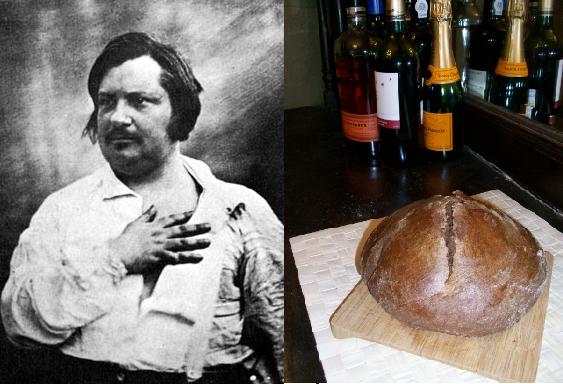
You might have seen the title of this post and had an immediate disconnect. Balzac and Ukrainian black bread? Wasn’t he more of a baguette kind of a guy? But that’s one of the things I love about Balzac. He was a baguette kind of guy. And a peasant bread kind of guy. And a traditional Easter paska bread kind of guy. He was just a man who loved food. He was a fan of the whole genre.

He is also one of the best writers of early “food erotica,” lingering over an account of a meal sometimes for several pages. Take one of his shortest descriptions in The Seamy Side of History: a breakfast of “monastic frugality” that “consisted of a small turbot with white sauce, potatoes, a salad, and four dishes of fruit: peaches, grapes, strawberries, and green almonds; then, by way of hors d’oeuvres, there was honey served in the comb as in Switzerland, besides butter, radishes, cucumber, and sardines.” If that’s what they’re serving at monasteries, sign me up.

Balzac’s encounter with Ukrainian bread happened late in life, but at a transformative moment. In 1832, he began a correspondence with one of his readers, a married woman living near Kiev who enigmatically signed herself “The Foreigner.” It was the beginning of a fifteen-year long-distance relationship – and soon Balzac found himself falling in love with his pen pal, Ewelina Hańska. So when her husband died in 1841, Balzac made his move, traveled to meet her, and eventually married her at her estate, in what’s now Ukraine.

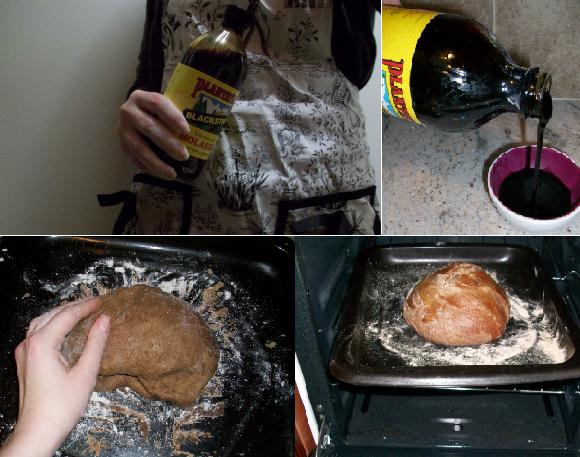
Ewelina wasn’t the only thing that impressed him about the country – the bread did. He famously counted 77 different kinds of bread-making techniques used there, a fact that local tourism brochures don’t hesitate to play up (Visit scenic Ukraine! Land of the fabled 77 breads!).  And one of the most popular (and most delicious) is the Russian black bread, which gets its color from dark rye flour.

* * *

Continue reading “Honoré de Balzac: Ukrainian Black Bread”