Ernest Hemingway: Bacon-Wrapped Trout with Corn Cakes

Were you expecting a stiff cocktail? Fresh marlin? Braised wildebeest? Ernest Hemingway has become such a legendary character, it’s hard to think of a recipe that could match his macho reputation. It’s clear that the man loved food; A Moveable Feast is one of the most sincere odes to eating I’ve ever read. But did Hemingway cook?

Whether on a Cuban beach or the African savanna, Hem was a fan of the good life – and that included making good food. “It is all right to talk about roughing it in the woods. But the real woodsman is the man who can be really comfortable in the bush,” he wrote in an essay on camping for the Toronto Star.  As a kid, Hemingway spent many summers hiking through Michigan, and his ideal meal was a freshly caught fish. But most of his fellow outdoorsmen didn’t know their way around a griddle. “The rock that wrecks most camping trips is cooking,” he griped. “The average tyro’s idea of cooking is to fry everything and fry it good and plenty.”

As a solution, he proposed a simple but satisfying meal for any campfire cook. Trout was a favorite for Michigan fishermen, but it can dry out easily. So Hemingway suggested cooking it in layers of bacon, whose fat bastes the fish as it renders. “If there is anything better than that combination the writer has yet to taste it in a lifetime devoted largely and studiously to eating.”

Of course, sometimes the hardest part of cooking isn’t preparing the meal itself – it’s waiting for it to be done. Hemingway saw that coming, too. He recommended whipping up a batch of pancakes to serve before the main course, to satisfy any unhappy campers.

* * *

Continue reading “Ernest Hemingway: Bacon-Wrapped Trout with Corn Cakes”
What Would Faulkner Eat? Recreating the Favorite Recipes of Famous Authors

“Any healthy man can go without food for two days – but not without poetry.” – Charles Baudelaire
“There is no love sincerer than the love of food.” – George Bernard Shaw

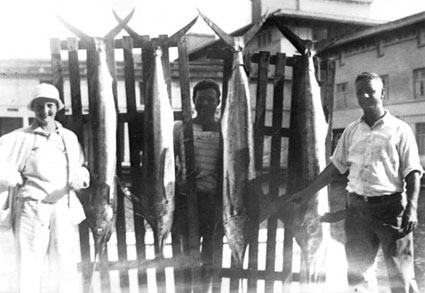
Hemingway in Key West, with future dinner

When Shakespeare said music was the food of love, I think he was only half right. Sure, couples get choked up when a band starts playing their song, and after a breakup every sad song on the radio seems made just for you. But personally, I’m more likely to get misty-eyed when someone invites me over to make risotto, or when sharing a lobster roll at the end of a pier. And when agonizing over why it didn’t work out, you know we all eat ice cream. Why indulge in metaphor? Food is the food of love.

With apologies to Baudelaire, after two days of hunger I would turn in all my collected poems for a good meal. And I can think of a lot of authors who would probably do the same. This blog was inspired by them.

A love of good books often comes with a love of good food.  It’s in the many mouth-watering descriptions we encounter in novels, the wealth of new food memoirs, and the explosion of incredible food writing and blogging online. But it isn’t just today’s writers that have a personal obsession with food. We hear about it in Ted Hughes’ letters, see it in Emily Dickinson’s recipes, and imagine it in Hemingway’s cafés. And when I hear about the food that inspired them, I want to eat it too.

This blog will attempt to recreate the dishes that iconic authors discuss in their letters, diaries, essays, and fiction. In doing so, it will be part historical discussion, part food and recipe blog, part literary fangirling. Above all, I hope it will be delicious.