D.H. Lawrence: Polenta with Sausage Ragù

D.H. Lawrence - Polenta with Sausage Ragu

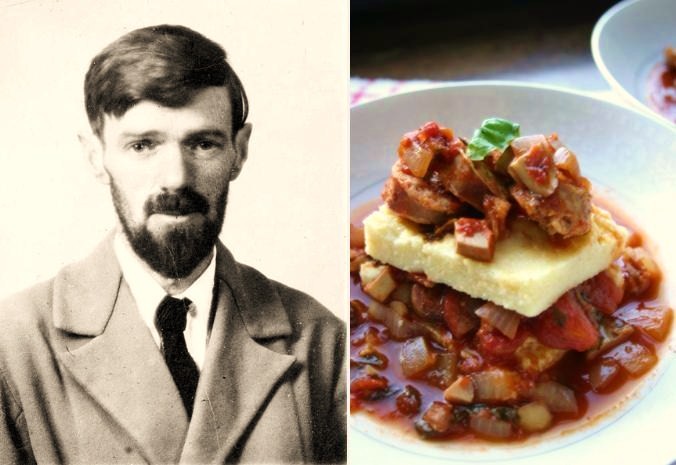
One hundred years ago, D.H. Lawrence was awaiting the publication of what would become his most famous (and most controversial) novel. Sons and Lovers celebrates its centennial this May—but in the weeks leading up to its release, Lawrence’s thoughts were elsewhere, in a little house across the Alps: “I want to go back to Italy,” he wrote.

Lawrence made his first trip to Italy while working on Sons and Lovers, and he felt an immediate connection. “I think I shall be happy there, and do some good work,” he said in 1912, just before settling near Lago di Garda, a few miles from Verona. Several months later, his writing was already moving along. “I do my novel well, I’m sure. It’s half done.”

But when taking a break from his desk, Lawrence was at work in the kitchen, which he praised in letters home. “There’s a great open fireplace, then two little things called fornelli – charcoal braziers – and we’ve got lots of lovely copper pans, so bright. Then I light the fornello and we cook. It’s an unending joy.” He found beauty in the smallest act of cooking—he loved his pots so much, he made sketches of them. Everything is just red earthenware, roughly glazed, and one can cook in them beautifully.”

For Lawrence, Italian cuisine meant a chance to experiment with ingredients of all kinds, from the quotidian to the obscure. “We eat spaghetti and risotto and so on all of our own making,” he wrote. “We eat quantities of soup … midday polenta made of maize flour boiled to a stiff porridge that one cuts in slices with a string … queer vegetables – cardi – like thistle stalks, very good – and heaps of fresh sardines.” He frowned upon the tendency of the locals to use too much oil, but had certain indulgences of his own: “Maggi and I grate pounds of cheese,” he admitted. 

If we’re lucky, we discover for ourselves what Lawrence found in Italy: that place that inspires all our creative pursuits, whether it’s at the desk or at the stove. The freedom and adventure he felt there, through, dissipated when he left Italy to go north. “I have suffered from the tightness, the domesticity of Germany. It is our domesticity which leads to our conformity, which chokes us.” Little did he know how non-conformist his new novel would be seen—a little reminder of Italy that lingered there. 

* * *

Polenta with sausage and mushroom ragu recipe

Continue reading “D.H. Lawrence: Polenta with Sausage Ragù”

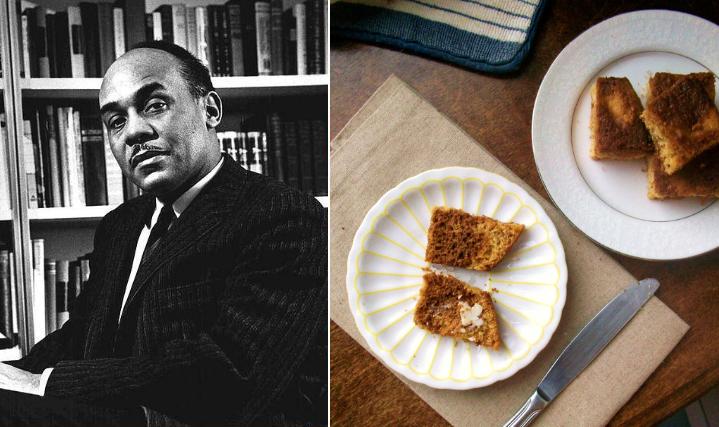
Ralph Ellison: Molasses Cornbread

There’s a scene in Ralph Ellison’s The Invisible Man that has become one of the most famous food passages in history. The unnamed narrator, passing a sweet-potato vendor on the road, is transported back to his childhood in the South, happily recalling meals of fried chicken and chitterlings – foods that soon became too racially charged for him to enjoy. But in this moment, the narrator is changed: He gets three orders of potato, newly determined to eat what he likes without shame. “I yam what I am,” he shouts, transformed (and if your mind went straight to Popeye, just remember what a dramatic effect food had on him).

Food unexpectedly changed the course of Ellison’s life: When he started studying music at the Tuskegee Institute, he also began working long hours in the dining hall, in order to pay off his tuition. You could find him on the early shift – 5 a.m. to 1 p.m. – baking cornbread and pouring bowls of molasses for the breakfast service. And after graduation, it was cooking – not music – that landed Ellison a job. Failing to score a coveted spot as a trumpeter in a military band, he instead found work as a cook on a Liberty ship, turning out versions of the Southern staples he learned at Tuskegee: cornbread, biscuits and fried pies.

It wasn’t until Ellison began traveling abroad, away from the Southern dishes that had defined his early years, that he realized how they had worked their way into his being. Living in Rome in 1956, Ellison wrote to his friend and fellow writer Albert Murray, “I got no way to get any corn bread … no sweet potatoes or yellow yams, a biscuit is unheard of – they think it means a cookie in this town – and their greens don’t taste like greens.”

Today fried chicken and stewed greens have gained gourmet cred – collard green risotto is totally a thing – but there will always be foods that feature guilt as a main ingredient. The phrase “you are what you eat” has become a grim warning, baking shame into things that ought to be enjoyed in moderation. We focus so much on the physical effects of our diet, it’s easy to forget that food can change us in other ways – ones that don’t involve calories or celery sticks but instead affect our minds and hearts: sweet potatoes for comfort, ice cream for renewal, chocolate for joy.

* * *

Continue reading “Ralph Ellison: Molasses Cornbread”

Ernest Hemingway: Bacon-Wrapped Trout with Corn Cakes

Were you expecting a stiff cocktail? Fresh marlin? Braised wildebeest? Ernest Hemingway has become such a legendary character, it’s hard to think of a recipe that could match his macho reputation. It’s clear that the man loved food; A Moveable Feast is one of the most sincere odes to eating I’ve ever read. But did Hemingway cook?

Whether on a Cuban beach or the African savanna, Hem was a fan of the good life – and that included making good food. “It is all right to talk about roughing it in the woods. But the real woodsman is the man who can be really comfortable in the bush,” he wrote in an essay on camping for the Toronto Star.  As a kid, Hemingway spent many summers hiking through Michigan, and his ideal meal was a freshly caught fish. But most of his fellow outdoorsmen didn’t know their way around a griddle. “The rock that wrecks most camping trips is cooking,” he griped. “The average tyro’s idea of cooking is to fry everything and fry it good and plenty.”

As a solution, he proposed a simple but satisfying meal for any campfire cook. Trout was a favorite for Michigan fishermen, but it can dry out easily. So Hemingway suggested cooking it in layers of bacon, whose fat bastes the fish as it renders. “If there is anything better than that combination the writer has yet to taste it in a lifetime devoted largely and studiously to eating.”

Of course, sometimes the hardest part of cooking isn’t preparing the meal itself – it’s waiting for it to be done. Hemingway saw that coming, too. He recommended whipping up a batch of pancakes to serve before the main course, to satisfy any unhappy campers.

* * *

Continue reading “Ernest Hemingway: Bacon-Wrapped Trout with Corn Cakes”